
Are Soluble Corn Fiber and Psyllium Husk the Same Thing?
No. They are not the same material, they do not come from the same kind of source, and they are not interchangeable in either a supplement or a food formulation. The confusion is understandable, because both are routinely filed under the same heading, “soluble fiber,” and that heading turns out to predict almost nothing about what either one does.
Start with what each one physically is. Psyllium husk is the seed coat of Plantago ovata, a plant grown commercially in India. That husk is roughly 70% soluble fiber, built mainly from arabinoxylan, a heavily branched polysaccharide that gives psyllium its defining behavior: it binds water and forms a gel. The husk itself is only 10–25% of the dried seed’s weight, which is one reason grade and purity vary so much between suppliers.
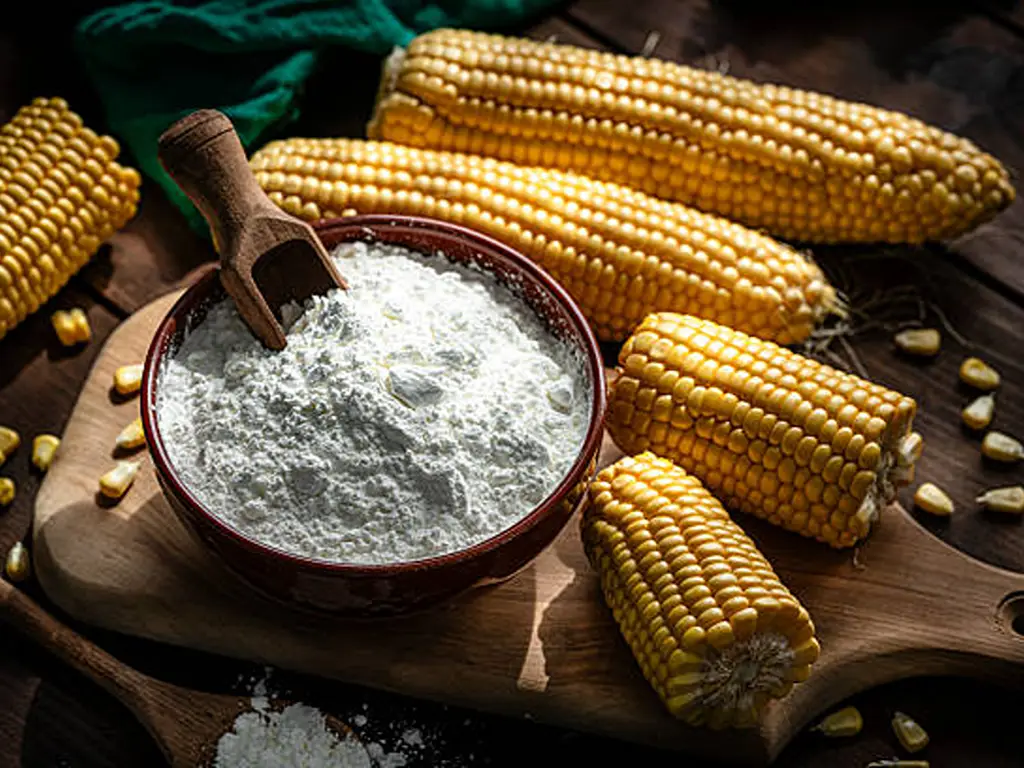
Soluble corn fiber is not a plant part at all. It is a starch derivative. Corn starch is treated under conditions that deliberately interrupt its breakdown, leaving glucose polymers that human digestive enzymes cannot cleave. The common commercial route is enzymatic hydrolysis; a thermal-acid route is also used. The result is also called resistant dextrin, resistant maltodextrin, or resistant maltodextrin/dextrin depending on the market and the regulatory filing.
That naming tangle causes real errors, so it is worth separating four things that are not the same:
| What you see on a label | What it actually is |
|---|---|
| Soluble corn fiber / resistant dextrin / resistant maltodextrin | The same starch-derived, largely indigestible glucose polymer, sold under different regional names |
| Maltodextrin (plain) | A digestible starch hydrolysate, typically DE 9–13, about 4 kcal/g, and it raises blood glucose |
| Corn fiber | Usually the insoluble outer fraction of the corn kernel; a different material with a different function |
| Wheat dextrin | A related but distinct dextrin, made from wheat starch; check the specification rather than assuming equivalence |
The practical takeaway is that a label reading “corn fiber” tells you very little until you confirm which of those you are holding. A label reading “soluble corn fiber” or “resistant dextrin” is specific.
So the answer to “are they the same?” is no. The more useful question is what makes them different, and that question does not have a marketing answer. It does not have a “soluble versus insoluble” answer either. It has a physical one.
The Property That Decides Everything: Viscosity, and Why “Soluble Fiber” Predicts Nothing
Soluble and insoluble is a laboratory solubility test. It tells you whether a fiber disperses in water. It does not tell you whether that fiber thickens, gels, ferments, feeds anything, or lowers anything.
The property that does carry that information is viscosity, meaning specifically whether the fiber forms a gel. A 2017 review in the Journal of the Academy of Nutrition and Dietetics put the point directly. Cholesterol lowering and improved glycemic control are “highly correlated with the viscosity of soluble fibers,” it found. Non-viscous soluble fibers such as inulin, fructooligosaccharides, and wheat dextrin “do not provide these viscosity-dependent health benefits” (McRorie & McKeown, J Acad Nutr Diet, 2017).
Viscosity’s close companion is fermentability, and the two tend to move in opposite directions. A gel-forming fiber resists fermentation because it stays structurally intact; a fiber that dissolves without thickening passes through to the colon largely intact and gets fermented there.
Three families, not two
Sort fibers by mechanism rather than by solubility and the category organizes itself:
| Mechanism | Fibers | What it produces |
|---|---|---|
| Viscous, gel-forming | Psyllium, beta-glucan, native guar gum, pectin | Bile-acid binding, delayed gastric emptying, slowed glucose absorption, increased stool water |
| Non-viscous, fermentable | Soluble corn fiber, polydextrose, inulin, FOS | Colonic fermentation, short-chain fatty acids, prebiotic effects, higher dose tolerance |
| Non-viscous, non-fermentable | Cellulose | Bulk only; no gel, minimal fermentation |
Soluble corn fiber sits squarely in the second family. Psyllium sits squarely in the first. They are neighbors on a warehouse shelf and strangers on this table.
What viscosity buys, and what it refuses to do
Psyllium’s clinical reputation is not an accident of marketing. The FDA authorized a coronary heart disease risk reduction claim for soluble fiber from psyllium seed husk under 21 CFR 101.81. The threshold is 7 grams or more per day of psyllium soluble fiber, with at least 1.7 g per serving in the food carrying the claim. Husk purity must be no less than 95%. The claim text itself is a statement about mechanism. It is a cholesterol-lowering claim, and cholesterol lowering is what a gel does.
Psyllium’s gel also explains its laxative behavior. The gel has high water-holding capacity and resists dehydration in the large intestine, which increases stool weight. The husk can hold up to roughly ten times its dry weight in water (Qaisrani et al., Journal of Environmental and Agricultural Sciences, 2016).
Soluble corn fiber does not do either of those things, at any dose. Its own regulatory pathway reflects a different physiological effect. In June 2018, the FDA issued guidance on additional non-digestible carbohydrates that could count as dietary fiber on Nutrition Facts labels. Resistant maltodextrin/dextrin was among the eight. The beneficial physiological effect cited was increased calcium absorption, not cholesterol reduction (FDA, 2018). The two fibers do not merely have different specs. They are recognized for different effects.
What non-viscous fibers buy instead
None of that makes soluble corn fiber a lesser fiber. It makes it a fiber for a different job, and the trade is not trivial.
Because it does not form a gel, it can be added at doses psyllium cannot reach. A double-blind controlled trial in healthy men tested a resistant dextrin at 30 g and 45 g per day over four to five weeks. Both doses were well tolerated, with gastrointestinal complaints hardly differing from placebo and no diarrhea reported (Pasman et al., Eur J Clin Nutr, 2006). A companion short-term study reported tolerance up to 45 g daily, with flatulence becoming possible in the 60–80 g/day range.
Compare that with the fructan family. In a randomized crossover trial, oligofructose was well tolerated at 5 g/day in healthy adults. At 10 g it substantially increased gastrointestinal symptoms. Native inulin was tolerated to about 10 g/day (Bonnema et al., J Am Diet Assoc, 2010). Tolerance is form-specific and highly individual, but the gap between a fructan’s comfortable dose and a resistant dextrin’s is real, and it decides which product formats each fiber can go into.
The dividing line is viscosity, not solubility: cholesterol and laxation belong to gel-forming fibers, and no amount of a non-viscous fiber substitutes for them. That single fact explains most of the practical differences that follow, in formulation, in label claims, and in what each fiber is worth to the person buying it.
What Each Fiber Actually Does Inside a Real Product
In a formula, psyllium is simultaneously a functional ingredient and a source of problems. Soluble corn fiber is barely perceptible, which is both its value and its limitation.
Psyllium’s gel does useful work. In gluten-free baking it substitutes for some of what gluten normally provides: structure, gas retention, a crumb that holds together. Practical starting guidance is around 2–5% of flour weight, hydrated along with the rest of the dough. Research on gluten-free systems has tested a wide span. One study examined 2.86%, 7.14%, and 17.14% psyllium on a flour-weight basis and found that higher levels improved structure, appearance, and texture while delaying staling. But the effect is not monotonic. A separate study substituted fibers at 5% and 10% of rice flour weight. Psyllium husk significantly reduced bread volume, producing a denser, harder texture. Inulin in the same trial gave a softer, more porous loaf. Concentration and hydration interact strongly and cannot be optimized independently. Excessive psyllium raises viscosity, competes for water, and restricts dough expansion.
Solubility behavior differs just as sharply. In a randomized double-blind trial of 72 patients with chronic constipation, participants rated the dissolvability of psyllium in liquid significantly lower than a comparison fiber. The scores were 3.63 versus 5.26 on a 10-point visual analog scale (p = 0.02) (Erdogan et al., 2016). Psyllium thickens the moment it meets water. That is the mechanism working, and it is also why it is difficult to disperse evenly and why clumping is a common complaint.
Soluble corn fiber behaves the opposite way. It dissolves without thickening, so it does not disturb a beverage’s clarity or viscosity, and it does not need to be balanced against the water content of a dough. Its processing window is correspondingly wide.
Specification discipline matters here, because the same category name does not lock the same product. Available grades span 70% and 90% fiber content on a dry basis, in powder and syrup form. The syrup grade is characterized by dry matter around 75%, water activity below 0.8650, and residual sugar under 2.0%. On the psyllium side, husk purity can range from roughly 70% to 99%. Performance differences between grades are large enough that a recipe developed on one grade may not reproduce on another.
The division of labor is clean. When a formulation needs viscosity, the ingredient that supplies it is a hydrocolloid such as xanthan, guar, or locust bean gum. A fiber is not the right tool, and asking soluble corn fiber to thicken is asking it to be something it deliberately is not.
If your formulation needs fiber without the viscosity, start with a specification.
Request a soluble corn fiber specificationFormulating With Each: Doses, Processing Windows, and Label Thresholds
Once the mechanism is settled, the formulation questions become concrete: how much, under what processing conditions, and what the label is allowed to say.
How much to add, by application
For soluble corn fiber, the practical inclusion ranges cluster as follows. These are industry-typical working ranges, not regulatory limits, and they shift with the rest of the formula:
| Application | Typical inclusion rate | Formulation note |
|---|---|---|
| RTD beverages | 3–8% | Dissolves without adding viscosity or haze |
| Protein powders and meal replacements | 5–15% | Near-neutral flavor keeps it from competing with the base |
| Bakery and snacks | 3–10% | No effect on crumb structure or mouthfeel |
| Sugar-free confectionery and gummies | 10–25% | Acts as both fiber source and bulk filler |
| Supplement capsules and powders | 20–50% | Low hygroscopicity suits moisture-sensitive actives |
| Plant-based dairy alternatives | 2–5% | No viscosity or flavor interference |
| Carbonated beverages | 2–5% | Acid-stable; fiber content survives at low pH |
Two patterns are worth noticing. The fibers that can carry the highest loads are the ones that change the product least. And the categories with the largest doses are the ones where a gel would be fatal.
Processing windows and label math
Soluble corn fiber holds its structure across a wide processing envelope. It is stable to roughly 160 °C, which covers UHT treatment, baking, and extrusion. It is also acid-stable to around pH 2.5. That matters in carbonated and fermented systems, where a less stable fiber would hydrolyze back into simple sugars and quietly reduce the fiber number on the label.
Label arithmetic is where mechanism turns into money. Under FDA labeling rules, a product needs at least 2.8 g of dietary fiber per serving to carry a “good source of fiber” claim. That figure is 10% of the 28 g Daily Value. The threshold rises to 5.6 g per serving for “high in fiber” or “excellent source of fiber” (20% DV) (21 CFR 101.54). At the inclusion rates above, most of those categories clear the thresholds comfortably, but only if the fiber survives processing.
The substitution matrix: when to swap, when not to
This is the decision table that matters most. It is organized around the question a formulator actually asks: my application is X, so does the swap work?
| Application | Psyllium vs soluble corn fiber | Switch when |
|---|---|---|
| Gluten-free bread and dough systems | Not interchangeable. Psyllium supplies structure; soluble corn fiber does not | Never as a 1:1 swap. If you need structure, keep psyllium or move to a hydrocolloid plus enzyme system |
| Plant-based meat and patties | Psyllium works as a binder at 1–3%; soluble corn fiber adds fiber without binding | Swap when binding is already handled by protein or starch and you only want fiber content |
| Clear and near-clear beverages | Psyllium clouds and thickens; soluble corn fiber stays invisible | Swap freely when the goal is fiber fortification or sugar reduction without texture change |
| Carbonated and acidic drinks | Psyllium’s gel weakens at low pH and can phase-separate | Swap when the system is below roughly pH 4 and stability is required |
| High-protein bars and shakes | Psyllium adds viscosity that fights a drinkable texture | Swap when the dose needed exceeds what psyllium’s texture allows |
| Gummies and sugar-free confectionery | Psyllium cannot serve as a bulk filler at these levels | Swap when the fiber is doing bulk or sugar-replacement work |
| Fiber supplements where the claim is cholesterol | Not substitutable; the claim follows the viscosity | Do not switch. Reformulating away from psyllium means giving up that claim |
| Constipation and stool-bulking products | Not substitutable; the laxative effect is the gel | Do not switch. Consider a blend instead |
The rule the table encodes: when the function the fiber performs is the gel, the swap fails; when the function is fiber content itself, it usually succeeds. Everything else is a detail of dose and processing.
Label thresholds for fiber claims
Source: 21 CFR 101.54
Where It Goes Wrong
Four failure patterns account for most of the trouble, and only one of them shows up in a lab.
Psyllium’s failures are process failures. Powder clumps when it is added to water too quickly, and clumps do not hydrate out; a gel pocket in a loaf stays a gel pocket. Hydration ratio and psyllium level are coupled, so adjusting one without the other usually makes things worse. Grade substitution is a silent failure too: because husk purity ranges from roughly 70% to 99%, moving to a cheaper grade can change the outcome without changing the recipe at all.
Soluble corn fiber’s failure is dose-related, and it comes from its own strength. Because the material reaches the colon and is fermented, sensitive individuals can experience gas and bloating at high intakes. The 30–45 g/day tolerance figure comes from a controlled trial in healthy men, so it is not a universal ceiling. Tolerance is highly individual, as it is for every fermentable fiber.
The procurement failure is specification drift. The same category name does not lock the same product across suppliers. Resistant dextrin is sold at pH ranges as different as 3.5–5.5 and 4.0–7.0, and declared shelf lives of 24 months and 36 months both appear in the market. A formulation developed against one supplier’s certificate of analysis may not reproduce on another’s, and the label will look identical.
The compliance failure is the most expensive, and it is a reasoning error rather than a technical one. Because psyllium carries an authorized coronary heart disease claim at 7 g/day, it is tempting to assume a different soluble fiber inherits it. It does not. The claim under 21 CFR 101.81 is specific to soluble fiber from psyllium seed husk. Soluble corn fiber’s route to the Nutrition Facts fiber line is a separate FDA action, based on a different physiological effect.
The claim trap: switching a product from psyllium to soluble corn fiber while keeping the cholesterol-reduction claim on the label is a labeling violation, not a formulation choice. The authorized claim follows the viscosity, and it follows the specific source.
None of these four is exotic. Each one has a cheap preventive check, and running them before committing to a specification costs an afternoon.
Before you commit to a specification
- Confirm which mechanism your formula depends on, gel or fiber content.
- Verify fiber content is stated on a dry basis, not as-is.
- Request the pH range and water activity, not just the fiber percentage.
- Ask for shelf life and storage conditions in writing.
- Ask whether the grade quoted is the grade that will ship.
- Confirm which claims the material can legally support in your market.
- Request a certificate of analysis for the specific lot, not a generic specification sheet.
Sourcing to Spec
The parameters above convert into a short list of things to put in an inquiry, and the faster they are on the table, the fewer samples get wasted.
Identity and composition: fiber content with its measurement basis (dry basis or as-is), DE value, form (powder or syrup), and for syrup, dry matter and water activity. Physical and chemical: pH range, ash, moisture, particle size or mesh, appearance. Safety: heavy metal limits and microbiological limits, stated numerically rather than as compliance claims. Commercial: packaging format, shelf life and storage conditions, minimum order quantity, lead time for stock versus custom material, and whether pricing holds across the grade you specified.
The documents matter as much as the numbers. Ask for a specification sheet, a certificate of analysis for each batch rather than one representative sample, origin and raw-material documentation, and any certification relevant to your market. A supplier that issues a per-batch COA can be audited; one that issues a single spec sheet cannot.
The distinction to hold onto is between a supplier that can hit your specification and one that can only sell you its catalog. The first will tell you which parameters are adjustable (viscosity, form and particle size, purity, DE value, pH, fiber content, water activity, packaging) and which are fixed by the process. The second will send a spec sheet and wait.
Six-step sourcing sequence
- 1Share requirements: application, formulation goals, processing conditions.
- 2Technical evaluation: which parameters are adjustable, which are fixed.
- 3Sample preparation and testing at pre-scale.
- 4Specification confirmation: performance, packaging, quantity, delivery schedule.
- 5Customized production to the confirmed spec.
- 6Delivery with documentation and support through application and scale-up.
The Business Read: Two Demand Chains, Not One Price Chain
Everything argued above has a commercial consequence, and for anyone selling ingredient fiber, it is the one that matters most.
Cholesterol reduction and laxation are viscosity-dependent. Soluble corn fiber does not produce them at any dose. What it does offer is zero viscosity, a tolerance ceiling that allows high-dose inclusion, stability across a wide processing window, and a regulatory pathway that is separate from psyllium’s. Those are not lesser facts. They are the whole basis of a different product category.
That means a buyer searching for psyllium and a buyer searching for soluble corn fiber are not shopping the same shelf at different price points. One is buying a gel and the claim that rides on it. The other is buying fiber content that does not disturb the product around it. Listing both under a single “fiber” line and quoting them against each other does two damaging things at once. It drags soluble corn fiber down to psyllium’s price anchor. And it loses the high-inclusion, sugar-reduction briefs that only a non-viscous fiber can serve.
The practical move is to stock them side by side rather than as substitutes. Give the sales conversation a single triage question: does this customer need the formula to thicken, or do they need it not to? That question, asked early, sorts the inquiry before a sample is shipped. And the categories where soluble corn fiber wins are consistent: clear beverages, high-protein bars and meal replacements, and sugar reduction where fiber fortification comes along for the ride.
Saigao Group manufactures soluble corn fiber and soluble tapioca fiber, the resistant dextrin grades this article describes. The range covers 70% and 90% fiber content, on corn and tapioca bases, in powder and syrup form. To be direct about scope: we do not supply psyllium husk. We would not position our fiber as a substitute for it, because the mechanism is different and the claim is different. What we can do is meet a specification. That includes 90-grade powder at ≥90.0% fiber on a dry basis, moisture ≤6.0%, ash ≤0.5%, and pH 3.5–5.5. We can also adjust viscosity, particle size, DE value, water activity, and packaging around your application. See our soluble corn fiber and soluble tapioca fiber range or send us your specification.
We manufacture soluble corn fiber and soluble tapioca fiber across 70% and 90% grades, on corn and tapioca bases, in powder and syrup. We do not supply psyllium husk, and we would not sell our fiber as a substitute for it.
Send Us Your SpecificationReferences
- U.S. Food and Drug Administration. “Guidance for Industry: The Declaration of Certain Isolated or Synthetic Non-Digestible Carbohydrates as Dietary Fiber on Nutrition and Supplement Facts Labels.” June 2018. fda.gov
- U.S. Food and Drug Administration. “21 CFR 101.54: Nutrient Content Claims for ‘Good Source,’ ‘High,’ ‘More,’ and ‘High Potency.'” ecfr.gov
- U.S. Food and Drug Administration. “21 CFR 101.81: Health Claims: Soluble Fiber From Certain Foods and Risk of Coronary Heart Disease.” ecfr.gov
- Erdogan, A. et al. “Randomised Clinical Trial: Mixed Soluble/Insoluble Fibre vs. Psyllium for Chronic Constipation.” Alimentary Pharmacology & Therapeutics 44(1):35-44, 2016. pmc.ncbi.nlm.nih.gov
- Journal of Experimental Agriculture International. “Arabinoxylans From Psyllium Husk: A Review.” 2016. jeas.agropublishers.com
 English
 Russian
 Spanish
 French
 Arabic