
Allulose has five answers to “what is it made from,” and which one you get depends on the layer you ask at. Ask at the crop and you get a plant; at the molecule, a rearranged sugar; at the border, a legal identity that changes country by country. This article walks the chain from field to label and stops wherever you stop. One clarification: allulose here means D-allulose, also written D-psicose. It is not sucralose, a chlorinated artificial sweetener with which it shares nothing but a syllable.
Start at the Crop: What “Made From Corn” Leaves Out
Allulose is a monosaccharide: a single-unit sugar, not a blend and not a polyol. Chemically it is D-psicose, one of the rare sugars, occurring in nature only in trace amounts. Its formula is C₆H₁₂O₆, identical to fructose; the difference is the configuration at one carbon. Allulose is the C-3 epimer of fructose.
How natural is it? The clearest single authority is China’s National Health Commission. Its Announcement No. 4 of 2025 approved D-allulose as a new food raw material, and it lists the plants the sugar occurs in: figs, kiwifruit and wheat. The quantities are far too small to extract commercially, so nobody makes it by pressing fruit.
Commercially, the starting point is a starch or sugar crop, and that crop travels several steps before it is allulose at all. Corn, cassava, sugar beet and sugarcane all serve; so do glucose and sucrose, which the Chinese approval text names as substrates for one of the two approved routes. When a product page says “made from corn,” it has compressed at least three steps (starch, then glucose, then fructose) into a single word. That compression is the gap most consumer-facing explanations leave open.
The five-step chain from field to molecule
Note“Made from corn” collapses the middle three steps into one word.
What comes out at the end behaves quite unlike sucrose once ingested. It tastes sweet at roughly 70% of sucrose’s intensity, and its energy contribution is very small: the regulatory energy factor applied in the United States and China is approximately 1.67 kJ/g, or about 0.4 kcal/g. Not every market uses the same factor, as the market-by-market section below shows. Supplier-published figures state that around 70% of an ingested dose is absorbed in the small intestine but not metabolised (there is no enzyme available to break it down) and is excreted in urine, while the remaining 30% or so passes into the large intestine. Blood glucose and insulin do not rise after ingestion, which is why ketogenic and diabetic diets allow it.
One boundary is worth knowing this early. Changing the starting crop is not cosmetic: it changes the raw-material identity you declare on an origin certificate, what a non-GMO claim rests on, and what goes into a European novel-food dossier. That is the first of two independent links. The second, the enzyme, closes further down.
One Carbon Flip: Why Allulose Is Fructose’s Mirror Image
The last step in the chain happens at the molecular level. Starch becomes glucose; glucose becomes fructose; and fructose becomes allulose through a single rearrangement. Allulose and fructose share the formula C₆H₁₂O₆ and differ only in how the groups sit around carbon 3. Allulose is not a different chemical substance; it is the same skeleton, mirrored at one position.
| Property | Fructose | Allulose |
|---|---|---|
| Molecular formula | C₆H₁₂O₆ | C₆H₁₂O₆ |
| Structural difference | — | C-3 epimer of fructose |
| Sweetness (sucrose = 100) | 100+ | ≈70 |
| Maillard / browning | reducing sugar | reducing sugar — browns fast |
Source: Client-published sweetness benchmark, sucrose = 100 reference; Maillard behaviour per the allulose syrup SKU page.
That single flip explains almost every complaint that comes out of a test kitchen. Allulose is a reducing sugar, so it takes part in the Maillard reaction, which is why a bake browns faster than the recipe expects. Its sweetness is only about 70% of sucrose’s, so a straight swap leaves the batch under-sweet. And its crystallisation behaviour differs, so finished goods come out softer and less crisp.
The practical consequence matters more than the chemistry: none of this is a defect in a particular supplier’s material. Every brand of allulose behaves this way, because the behaviour comes from the molecule. The fix lives in the formula, not in the purchase order.
Among the sweeteners it is usually compared with, allulose occupies a different slot. Erythritol lands at a similar sweetness and is also near zero-calorie, but it brings a cooling sensation that rules some applications out. Stevia and monk fruit are far sweeter than sucrose and generally need a blend partner. Allulose is a bulk sweetener in its own right: it stands in for sucrose one-for-one by volume without a blend partner.
That 1:1 replacement holds only where the product does not depend on sucrose’s crystallisation or browning. In confectionery, where structure comes from crystallisation, and in baking, where colour and crispness come from browning, the formula has to be rebuilt rather than adjusted. The checkable step: confirm whether your finished product depends on sucrose’s crystallisation or browning behaviour before you set a replacement ratio.
The Step That Turns Fructose Into Allulose — and the Routes That Are Approved
The step itself is an enzymatic epimerisation. The substrate is fructose, and the catalyst is D-allulose-3-epimerase, an enzyme that rearranges the molecule’s configuration without changing its formula. That distinction matters to anyone filling out a vegetarian, halal or kosher checklist: rearranging a configuration is not a chemical synthesis, and reaction type is one of the four criteria you will be judged against.
There is a second approved route: one-step microbial fermentation, starting from glucose or sucrose. This is not a rival camp in a debate. Both routes are recognised together in the same regulatory text: Announcement No. 4 of 2025 names both, and names the enzyme. Anyone who meets these two described as competing methods is reading a framing the regulation itself does not use.
Four criteria — and why the same batch scores differently under each
- 1. Crop-origin criterionwhich plant did the carbon come from?
- 2. Reaction-type criterionwas the transformation enzymatic or chemical?
- 3. Natural-occurrence criteriondoes the molecule occur in nature?
- 4. Regulatory-definition criterionhow does the authority in your market classify it?
WarningSwitching criteria on the same batch can reverse the conclusion. That is why public sources contradict themselves on a single page.
Whether a batch counts as “natural” or “synthetic” depends on which of those four you apply. The same batch can come out opposite depending on the choice, which is why public sources contradict themselves inside a single page. They are not disagreeing about the goods. They are switching criteria mid-argument.
One further difference between the two routes does not sit in the reaction at all. It sits in what happens after the reaction stops, and it is large enough to explain why allulose costs what it costs.
The criterion problem is not a problem with the cargo, so the fix is not a cargo fix. Decide which criterion your own labelling uses and stay internally consistent with it before you ask whether a batch is “natural.” What to request from a supplier is a written statement of process route and catalyst identity, not a one-word “natural.”
Why the Reaction Stops at 30%, and Why That Decides the Price
The reaction that makes allulose is reversible. That one property is the origin of the product’s price, and following it forward moves the cost centre somewhere most explanations never go.
Where the cost actually lands
The Equilibrium: Why the Reaction Stops Around 30%
Enzymatic isomerisation runs toward an equilibrium rather than to completion. The figure most often cited from laboratory work is 500 g/L of D-fructose converting to roughly 150 g/L of D-allulose, a conversion of about 30%, with an equilibrium ratio near 30:70 allulose to fructose. The precise number shifts with the enzyme, the temperature and the substrate concentration, but the order of magnitude does not.
The implication is the part that matters. At the moment the reaction finishes, most of the tank is still fructose. You have not produced a pure product. You have produced a mixture, and everything after this point exists to undo that.
The Consequence: Separation, Not the Enzyme, Is Where the Cost Sits
Decolourisation removes colour bodies and impurities picked up during conversion. Separation splits the stream. Concentration strips water so the next stage is not handling a dilute feed. Chromatography, usually a simulated moving bed, does the actual work of isolating allulose from fructose. Crystallisation turns the purified liquor into a solid, or, if the chain stops earlier, leaves it as syrup. Each step exists because the previous one left the stream in a state the next cannot accept.
Chromatography is not optional, and the reason is the molecule itself. Allulose and fructose share the same formula and the same mass. Boiling points, densities and ordinary filtration cannot tell them apart; only a separation that works on molecular shape can. This is also the answer to a question buyers ask about the paperwork: the purity figure on a certificate of analysis comes off a chromatographic measurement, not an arithmetic estimate.
The causal conclusion: the bulk of the cost sits in the separation burden, not in the enzyme. Same feedstock, same enzyme, higher target purity: the separation load rises with it. Batch-to-batch consistency is generated in the same place, which is why two suppliers quoting the same purity can still differ in how tightly they hold it.
| Metric | Enzymatic conversion | One-step fermentation |
|---|---|---|
| Substrate | Fructose | Glucose or sucrose |
| Equilibrium yield | ≈30% (500 g/L fructose → ≈150 g/L allulose) | >60% reported, laboratory scale |
| Separation burden | High — chromatography is mandatory | Would be removed if commercialised |
| Commercial status | Current commercial route | Research result, not a commercial process |
Source: Equilibrium figures per peer-reviewed D-allulose 3-epimerase literature; >60% yield per Taylor et al., npj Science of Food, 2023.
A judgement, stated as a judgement: the pattern behind unusually low quotations is usually a purity-and-separation story rather than a cheaper enzyme. Public sources do not publish a price-to-purity correlation, so this is reasoning from the cost structure above, not a cited statistic.
Where This Reasoning Stops Applying
Three limits.
First, 30% is the equilibrium ceiling of the enzymatic route. It is not a law covering every route. If a supplier proposes something else, re-check the numbers against that route rather than importing this figure across.
Second, the one-step fermentation route has been demonstrated at yields above 60%, but that is a laboratory result. It comes from a 2023 study in npj Science of Food by a university group working with a corporate research institute. The researchers have stated publicly that much more work remains before it could be translated into a commercially viable production method. Write it as a conditional: if commercialised, it would remove the costly separation step. It is not a current commercial process and does not replace the enzymatic route today.
Third, separation burden also depends on the target grade and purity basis you specify. The checkable action when a quotation arrives: read the certificate of analysis for purity (dry basis), ash and microbiology first, and discuss price second.
Where the Chain Stops: The Form You Actually Receive
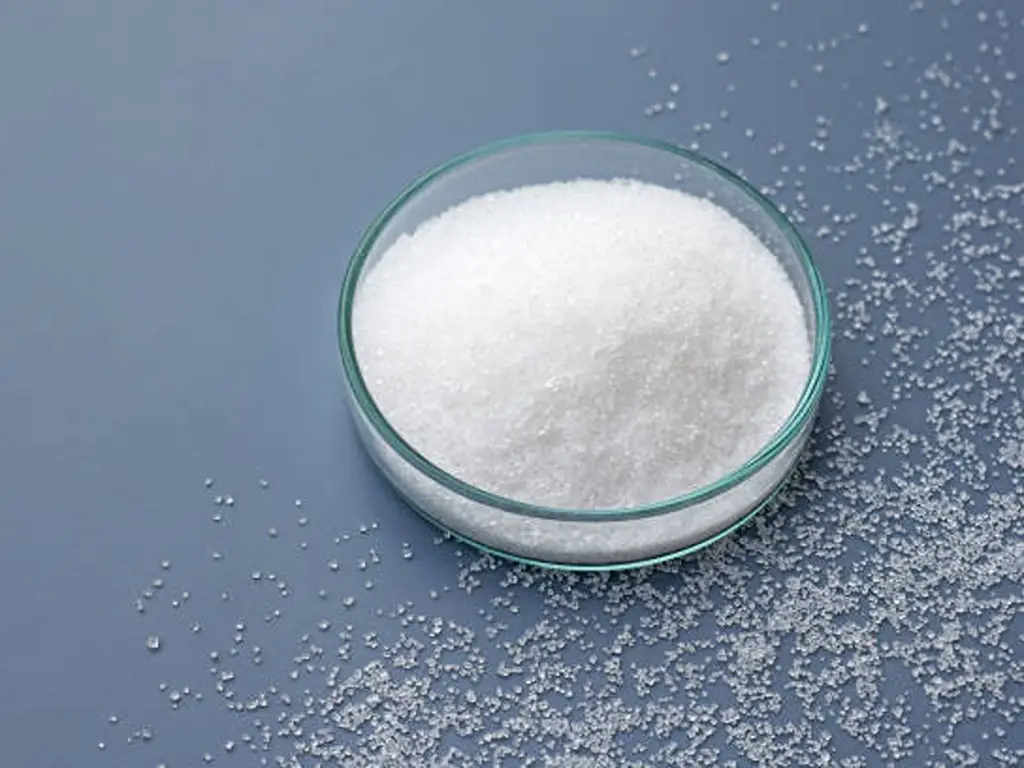
Form is not a packaging choice. It is a record of where the chain stopped. Take the sequence all the way through crystallisation and you have allulose crystal. Stop at concentration and you have allulose syrup. Other positions exist along the same axis: a finer or coarser particle size within the crystal family, blended products, finished tabletop sweetener formats. But the two forms you will actually be quoted on are crystal and syrup.
The two forms do not share a spec sheet, and that is the structural fact to take away. Each carries its own core specification lines, which is what makes each one separately comparable across suppliers.
| Spec line | Allulose Crystal | Allulose Syrup |
|---|---|---|
| Core specification lines | Purity (dry basis) · Ash · Microbiology | Dry matter · Water activity · pH |
| Physical form | White crystalline granular or powder | Colourless or light-yellow liquid |
| Dominant factor | Comparable universal indicators — cross-supplier price comparison is straightforward | Application-driven — the downstream line sets the spec |
| Line match | Dry blending and dry-mix systems | Liquid metering systems |
| Customisation |
| All of the crystal-side axes, plus syrup viscosity |
Form settles three things. First, which downstream line can take it: crystal is built for dry blending, syrup for liquid metering. Second, storage and transport conditions. Third, and this is the one buyers underuse: how much room there is for customisation. Form and particle size, purity and content, pH, water activity and packaging are all adjustable, and in the syrup case viscosity is on the table as well.
Application verticals are a triage question, not a section of their own. Liquid systems such as beverages and alcohol go to syrup. Dry systems such as powdered beverage mixes and dry blends go to crystal.
The checkable step is easy to get backwards: confirm the syrup’s dry matter and water activity, or the crystal’s particle size distribution, before you choose a form. Do not choose a form by which one tastes better. Note also that particle size distribution is something you request from a supplier rather than a number to assume.
What’s Still in the Bag: Processing Aids, Residuals, and the GMO Question
What arrives in the bag is not only allulose. The rows that tell you what else is in there live on the certificate of analysis. The processing aids behind them fall into distinguishable cases, each with its own consequence for what you can print.
Residuals and processing aids: what to look for, and what it means
- Immobilised enzymecan be removed by filtration
- Free enzymemust be inactivated, and the inactivation must be documented
- Recombinant enzyme from an engineered microorganismused as a processing aid; where it is not present in the finished product it does not trigger bioengineered labelling
- Unreacted fructose and glucoseread as a line on the COA
- Ash, moisture, 5-HMFread as lines on the COA, not as marketing statements
“Is it GMO?” has no single answer, and this is the part buyers most often get wrong. It depends on two independent links: the raw-material crop and the enzyme source. A Chinese production line commonly runs on non-GMO corn. Another common supply chain pairs GMO corn with an enzyme expressed in an engineered microorganism. Because the two links combine independently, four cases exist, and the honest answer to the question is whatever that combination says. This is the second link planted back at the crop.
Vegetarian, allergen and religious (halal, kosher) checklists all want the same thing: a statement about where the processing aids came from. That request is no longer unusual. A vegetarian organisation’s ingredient database collects written statements from multiple suppliers on animal-derived processing aids, which means the ask has become institutionalised rather than awkward.
So the checkable action is this: ask for batch-level documents first (batch inspection report, certificate of origin and certificate of analysis), then confirm the identity-preservation method and the adventitious-presence threshold basis you are being held to. “Non-GMO” is not a sentence. It is a set of documents.
What It Is Legally, Market by Market — and What You Can Print
One Molecule, Different Legal Identities: Market by Market
Start with the United States, and note that two things are true at the same time. Allulose is a monosaccharide, and under the current regulation it is still a sugar. Separately, the agency’s enforcement-discretion guidance, in place since 2019, permits allulose to be excluded from Total Sugars and Added Sugars on the label. Both statements stand. The order matters, and the second does not erase the first.
The European Union is a different status again, and the word matters. Allulose is an unauthorised novel food, not a banned substance. A ban is a prohibition; an unauthorised novel food is one on which no positive safety opinion exists to base an authorisation. The European Food Safety Authority’s panel concluded that “the safety of the NF, i.e. D-allulose, cannot be established” (EFSA Journal 2025;23(6):e9468, 5 June 2025). The cause was procedural: the applicant did not answer the panel’s repeated requests for data on the substance’s identity, the production process, proposed uses and use levels, genotoxicity and human data.
China’s position is the most concrete. Announcement No. 4 of 2025, published on 2 July 2025, approved D-allulose as a new food raw material and recognised both production routes in the same document. It sets content at ≥98 g/100 g and a recommended intake of ≤20 g per day. It also states that infants, pregnant women and nursing mothers should not consume it because safety data for those groups is insufficient. That last limit is a real consumer-facing restriction and belongs in the label discussion. The same announcement records where the molecule stands internationally: GRAS in the United States, a natural health product ingredient in Canada, and approved as a novel food in Australia and New Zealand.
| Market | Status | Note |
|---|---|---|
| United States | Permitted; GRAS | Still a sugar under the regulation; enforcement-discretion guidance since 2019 permits exclusion from Total and Added Sugars |
| European Union | Unauthorised novel food | Not banned — no positive safety opinion; EFSA Journal 2025;23(6):e9468, 5 June 2025 |
| China | Approved as a new food raw material | Announcement No. 4 of 2025, published 2 July 2025; both routes recognised; ≥98 g/100 g; ≤20 g/day |
| Australia & New Zealand | Approved as a novel food | Application A1247; amendment gazetted 29 October 2024, in force from 2024 |
| Canada | Recognised as a natural health product ingredient | Ordinary-food use still a grey area |
| Japan | Approved | — |
| South Korea | Approved | — |
| Mexico | Approved | — |
| Singapore | Approved | — |
| United Kingdom | Not approved | — |
Source: Announcement No. 4 of 2025 (NHC); EFSA Journal 2025;23(6):e9468; FSANZ Application A1247 / Amendment No. 233.
Australia and New Zealand show how far one market’s permissions sit from another’s. The approved route there is enzymatic conversion of fructose using D-psicose 3-epimerase from a specified organism. Maximum permitted levels run from 100% in tabletop sweeteners to 10% in bakery products and 3.5% in non-alcoholic water-based flavoured drinks, and retail sale is permitted only where the food is a tabletop sweetener. Labelling must carry a laxative-effect advisory, and nutrition labelling uses an energy factor of 2 kJ/g. Against China’s ≈1.67 kJ/g, that is a different calorie figure for the same molecule, so do not carry one global number across markets.
One more thing argues for checking this yourself: a major supplier’s consumer-facing FAQ still lists only four markets, missing Australia and New Zealand’s 2024 approval, China’s 2025 approval, and Mexico, Korea, Japan and Singapore.
The Declaration Is the Exposure: What the Courts Have Done Lately
Two things, in sequence.
First: the 2020 enforcement-discretion guidance still exists, and it still permits the exclusion of allulose from Total and Added Sugars.
Second: in Franco v. Chobani, LLC, 184 F.4th 599 (7th Cir. 2026), a federal appellate court revived a nationwide class action. The district court had dismissed it on federal preemption grounds, and the appellate court reversed. Its reading of the rule: a food cannot be labelled sugar free unless it has less than half a gram of sugar per serving, and sugars include every monosaccharide, including allulose.
Enforcement discretion is not a safe harbour
Franco v. Chobani, LLC, 184 F.4th 599 (7th Cir. 2026)
The declaration is a document. Put it in the file before it goes on the pack.
The binding scope is narrow: federal courts in Illinois, Indiana and Wisconsin only. That is not comfort. It means the next case may be filed in your district.
The trend is what turns this from a legal footnote into a commercial fact. In August 2026 alone, three follow-on suits were filed, aimed at “0g Sugar”, “Zero Added Sugar” and “ZEROg Added Sugar” claims on allulose-sweetened products. One law firm’s count of related cases runs past a dozen. An open question commentators are watching is how far the same reasoning extends to “no added sugar”.
The conclusion is not that such claims are unusable. It is that the declaration needs its own review, separate from the specification review: the court has already made clear that enforcement discretion is not a shield.
The Boundary Matrix: Your Scenario × What Works × What to Check First
| Downstream scenario | Which route or form works | Check first (a verifiable action) |
|---|---|---|
| Making a “0 sugar / no added sugar” claim in the US | Both crystal and syrup work, but the claim itself needs separate review | Check the actual per-serving content of the finished product against your district’s threshold first, then check the enforcement status in that district — the court has already held that enforcement discretion is not a safe harbour |
| Entering the EU channel | Both process routes are equally unauthorised | Confirm first whether the material falls within the novel food category and whether a dossier has been filed and the authority’s data requests answered; “banned” is the wrong term — the correct term is “unauthorised” |
| Entering the China channel | Both approved routes work | Check the label’s intake advisory (≤20 g/day) and the population restriction first; verify content against the ≥98 g/100 g standard |
| Declaring non-GMO or origin | Depends on two independent links — the raw-material crop and the enzyme source | Ask for batch-level documents first (batch inspection report, certificate of origin, COA), then confirm the identity-preservation method and the adventitious-presence threshold basis |
| Liquid vs dry-blend downstream line | Syrup for liquid metering, crystal for dry blending | Check the syrup’s dry matter and water activity, or the crystal’s particle size distribution, before fixing the form; do not choose a form by taste |
| Downstream needs the word “natural” | This is a criterion-selection question, not a property of the goods | Decide which criterion you adopt and make the packaging self-consistent with it first; the same batch yields opposite conclusions under different criteria |
Source: Synthesised from the regulatory and litigation facts above.
If You’re the One Selling It: Put the Source File Before the Quotation
If you are the one moving this material, what you sell is not a bag of powder. It is a source file: one your downstream can interrogate and your own import compliance can accept. The three constraints argued above all land on documents rather than on price or taste. The US labelling litigation is a declaration problem. The EU status is a dossier problem. China’s approval attaches intake limits and population restrictions to the specification itself. Price moves with the equilibrium ceiling and the separation burden; taste is common to the entire category. Neither is a moat.
So move the file earlier. The specification sheet, the certificate of analysis, the process route statement, the certificate of origin and the non-GMO identity-preservation documents belong before the selection decision, not in the after-sales inbox.
Where the document threshold sits in a selection flow
NoteThe document step is the one that normally happens last and should happen first.
The pressure runs one way: from the end consumer to your downstream customer, to you, to your supplier. You are the node carrying it. That this questioning has become routine is visible in the institutional record rather than in rhetoric. A vegetarian organisation’s ingredient database collects written statements from multiple suppliers about the origin of their processing aids. That only happens once buyers make the ask as a matter of course.
Stock structure follows from the same reasoning, in two layers.
| Layer | Crystal | Syrup |
|---|---|---|
| Role | General-purpose base | Application-specific fitting |
| Basis for ordering | Core specification lines are comparable across suppliers; turnover is predictable | Ordered against a downstream application and a chosen customisation axis |
| Consequence for inventory | Hold to cover expected volume | Hold against identified demand, not against a forecast |
And when a quotation lands noticeably below the others, read the certificate of analysis first (purity on a dry basis, ash, and microbiology), then discuss the price.
This ordering holds in markets where your downstream needs claims, or where you have to clear import compliance yourself. In a market driven purely by price, the document threshold sits somewhere else entirely. The starting move is to list the three questions your downstream will actually ask you, then work backwards from those to the documents you need to hold.
Two of those documents look like this. SAIGAO publishes both specification sheets openly. The crystal grade runs to D-allulose ≥98.5% on a dry basis, ash ≤0.1% and total bacteria ≤300 CFU/g. The syrup grade runs to ≥95.0% allulose on a dry basis with dry matter ≥70.0% and water activity below 0.75, under enterprise standard Q/CSG0009S. We issue the certificate of analysis and specification sheet on request or with a sample order. See our allulose crystal specification and our allulose syrup specification.
“Made from” has as many answers as the chain has layers, and the answer you need depends on what you intend to do with the material. By the time the chain reaches its final layer, what decides whether you can sell is never the powder itself; it is the source file that travels with the goods. A workable first move: write down the three questions your downstream customer will ask you, then reverse that list into the documents you need to be holding before you take a quotation.
References
- National Health Commission of the People’s Republic of China. “Announcement on 20 ‘Three-New Foods,’ Including D-Allulose (Announcement No. 4 of 2025).” 2025. zwfw.nhc.gov.cn
- National Health Commission of the People’s Republic of China. “Interpretation of the Announcement on 20 ‘Three-New Foods,’ Including D-Allulose (Announcement No. 4 of 2025).” 2025. zwfw.nhc.gov.cn
- National Health Commission of the People’s Republic of China. “D-Allulose and Four Other New Food Ingredients” (route annex). 2025. nhc.gov.cn
- EFSA Panel on Nutrition, Novel Foods and Food Allergens. “Safety of D-allulose as a novel food pursuant to Regulation (EU) 2015/2283.” EFSA Journal 2025;23(6):e9468, 5 June 2025. efsa.onlinelibrary.wiley.com
- United States Court of Appeals for the Seventh Circuit. Franco v. Chobani, LLC, No. 25-2087, 184 F.4th 599 (7th Cir. 2026), decided 27 July 2026. law.justia.com
- Food Standards Australia New Zealand. “Application A1247 — D-allulose as a novel food,” and Food Standards (Application A1247 — D-allulose as a novel food) Amendment No. 233, gazetted 29 October 2024. foodstandards.gov.au
- Taylor, J.E., et al. “Awakening the natural capability of psicose production in Escherichia coli.” npj Science of Food, 2023. nature.com
- “The Characterization of a Novel D-allulose 3-Epimerase” (WO2018087261A1) — 500 g/L D-fructose to 150 g/L D-allulose, 30% conversion yield. patents.google.com
- Liu, H., et al. “Optimization of fermentation conditions for whole cell catalysis.” Scientific Reports, 2024. nature.com
- Morrison & Foerster. “Allulose Claims Face Growing Class Action Scrutiny.” 1 September 2026. mofo.com
- ClassAction.org. “Liquid Death Lawsuit Alleges ‘0g Sugar’ Sparkling Energy Drinks Are Falsely Advertised.” 27 August 2026. classaction.org

 English
 Russian
 Spanish
 French
 Arabic