
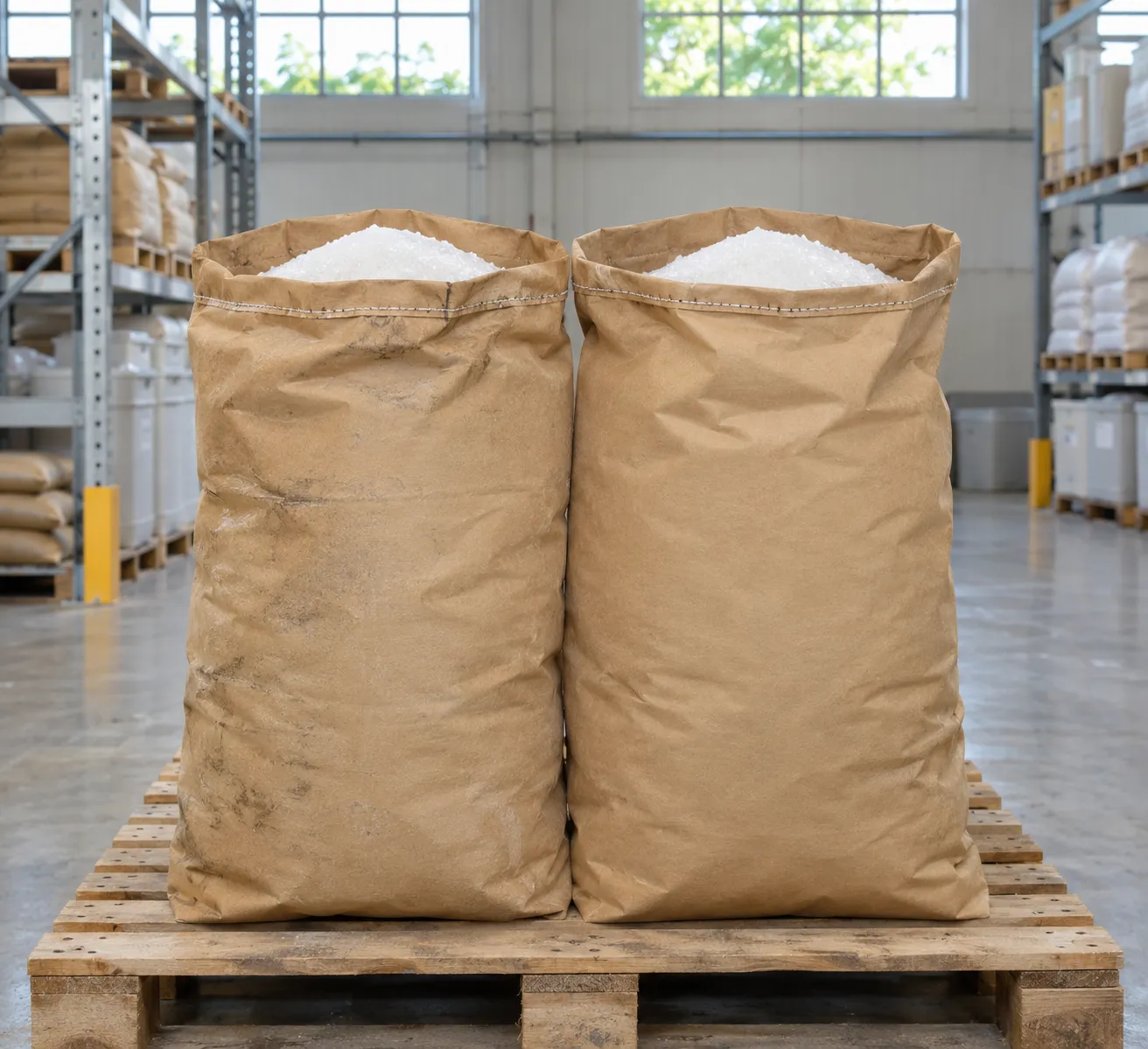
Two 25 kg bags sit side by side in the ingredient store. One reads maltitol (E 965), the other sorbitol (E 420). The crystals look identical, the price per kilo is close, and both turn up in the same sugar-free gummies, chocolates and chewing gums. That resemblance is exactly why the two get treated as interchangeable. They are not.
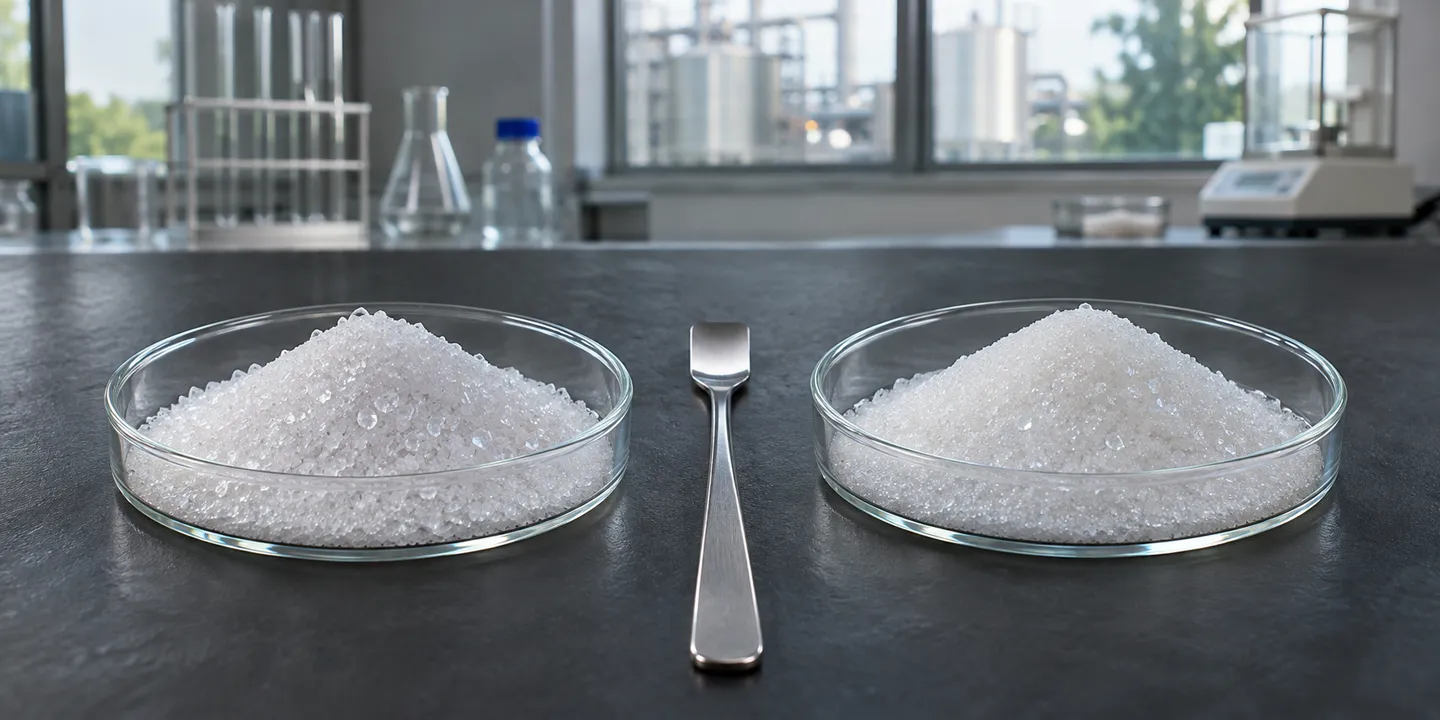
Both are sugar alcohols, the polyol family that also includes xylitol, erythritol, lactitol and isomalt. Maltitol is made by hydrogenating maltose, so it inherits a disaccharide skeleton; sorbitol is made by hydrogenating glucose and inherits a single-sugar skeleton (Msomi et al., 2021). In weight terms the difference is stark: maltitol has a molar mass of 344.31 g/mol, sorbitol 182.17 g/mol. One letter apart on a label, twice the molecule. Almost everything that separates them downstream, from how they behave in your gut to how they behave in a freezer, traces back to that size difference.
One clarification before going further. The sorbitol name also appears on pharmacy shelves as an over-the-counter laxative vehicle. That is a different product category entirely; this article is about the food ingredient.
On calories, the two are a tie. EU Regulation 1169/2011 assigns every polyol a labelling conversion factor of 2.4 kcal per gram, against 4 for sucrose (Règlement (UE) n° 1169/2011, 2011). Measured energy values run a little higher, around 2.6 to 3.0 kcal/g depending on the polyol (Centre for Food Safety, Hong Kong, 2024). So when a spec sheet quotes 3.0 kcal for maltitol and 2.6 for sorbitol, both numbers are right. They just carry different qualifiers than the EU label factor. On sweetness there is a real gap. Maltitol sits at roughly 75 to 90 percent of sucrose, and sorbitol at 50 to 70 percent, with maltitol syrup forms lower still (Centre for Food Safety, Hong Kong, 2024).
Identity card: maltitol vs sorbitol
| Propriété | Maltitol | Sorbitol |
|---|---|---|
| Source molecule | Hydrogenated maltose (disaccharide) | Hydrogenated glucose (monosaccharide) |
| Molar mass | 344.31 g/mol | 182.17 g/mol |
| Sucrosité vs saccharose | 75-90% (crystalline) | 50-70% |
| Énergie | 2.4 kcal/g EU label factor (measured 2.6-3.0) | 2.4 kcal/g EU label factor (measured 2.6) |
| E number | E 965 | E 420 |
That size difference is not a trivia footnote. It decides how each molecule is handled in the small intestine. The gut decides the blood sugar story; the blood sugar story decides the dose ceilings; and those ceilings decide what goes on the label. The rest of this article walks that chain in order, and it ends where every ingredient decision should: at the purchase order.
One Letter Apart: How Your Body Handles Them Differently
Two Molecules, Two Metabolic Paths
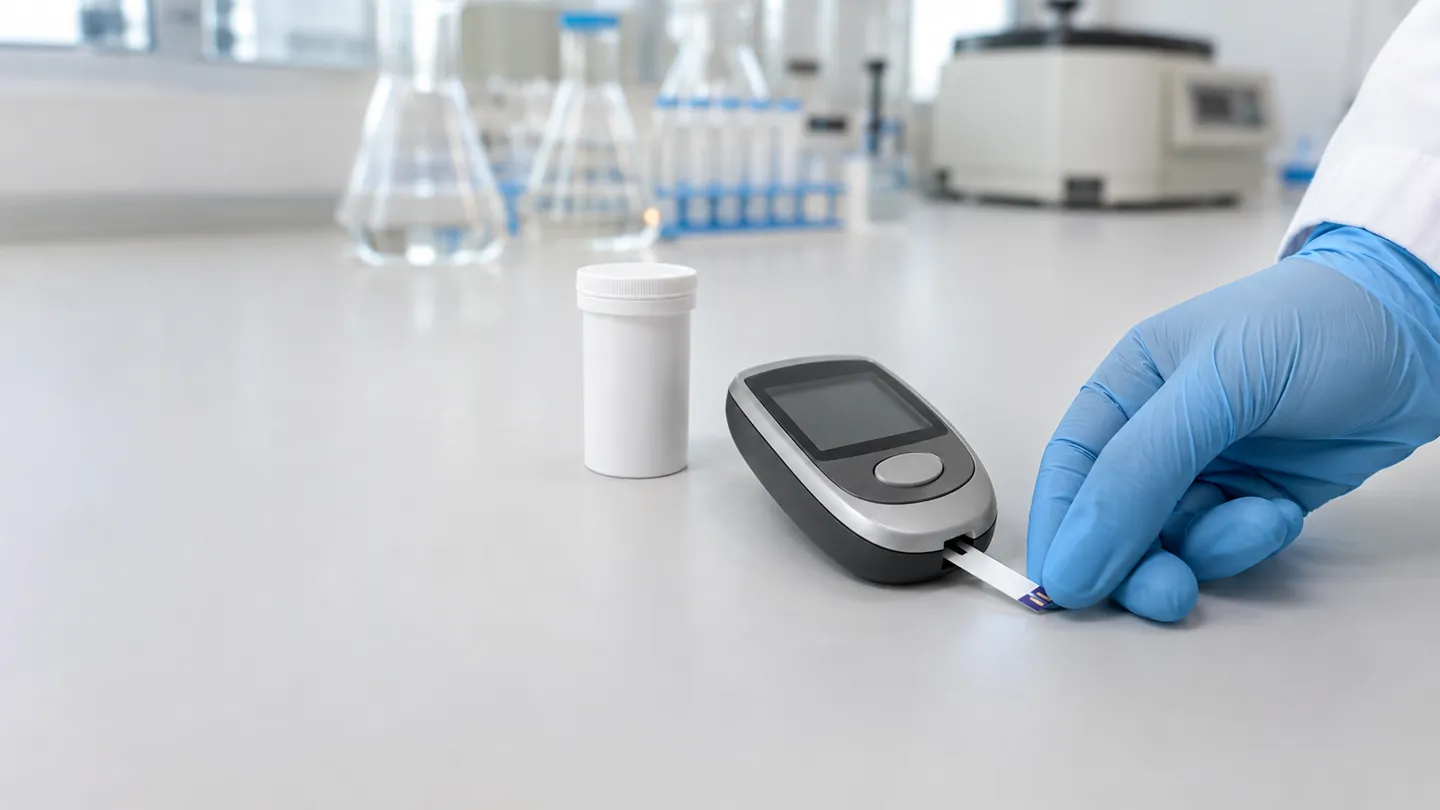
Maltitol starts breaking down before it gets far. Intestinal enzymes hydrolyse it into glucose and sorbitol, and a meaningful fraction is absorbed, which is why maltitol produces a measurable blood sugar response. Sorbitol is already a single small molecule, and it is partially absorbed directly. A review of polyol metabolism puts the absorption spread across the family at roughly 0 percent for lactitol up to nearly 80 percent for sorbitol (Msomi et al., 2021). Whatever is not absorbed reaches the colon, where it does two things at once: draws water osmotically and feeds fermenting gut bacteria. That combination is the mechanism behind the gas, cramps and laxative effects that fill the review sections of sugar-free candy.
The classic dose studies make the contrast concrete. In healthy subjects, single doses of 25 or 50 g of sorbitol did not significantly elevate blood glucose. That observation dates back to work in the 1940s and has been repeated since (Msomi et al., 2021). Maltitol behaves differently: a single 50 g dose produced significantly lower glucose and insulin responses than sucrose, lower, but plainly not zero (Msomi et al., 2021). Both molecules are kinder to blood sugar than table sugar. They are not in the same lane as each other.
Counting Carbs When the Sources Disagree
Here is where buyers and label readers both get burned. Published glycemic index numbers for these two polyols disagree, and the disagreement is systematic, not random.
Published GI figures and where they come from
| Formulaire | Commonly cited GI | Source and qualifier |
|---|---|---|
| Maltitol crystalline | ~35 | International GI tables (Atkinson 2008 via secondary sources) |
| Sirop de maltitol | ~52 | Supplier data; syrup hydrolyses faster |
| Sorbitol | ~9 | International GI tables; supplier pages often claim 0 |
| “Zero GI” claim for sorbitol | 0 | Seen on supplier marketing pages; contradicted by community reports of delayed glucose effects |
The direction is consistent everywhere: both sit well below sucrose, and maltitol sits above sorbitol. The magnitude is where the arguments live, because the numbers move with the form (crystalline versus syrup), the test protocol and the source’s commercial interest. Low-carb communities have settled on a working rule that captures this uncertainty: count roughly half the carbohydrate from maltitol as effective carbs (r/keto community practice, ongoing). It is a hedge, not a measurement, and the syrup forms deserve a harsher discount than the crystals. For a diabetic consumer, the safe reading is: sorbitol-lowered expectations with eyes open, maltitol counted, never assume either is free.
Tolerance, Dose and the Failures People Actually Report
Regulators have already drawn the lines. In the EU, any food carrying more than 10 percent added polyols must state that excessive consumption may produce laxative effects (Beltrá et al., 2022). In the United States, the codified trigger is narrower. Foods whose foreseeable consumption could reach 50 grams of sorbitol per day must bear the statement “Excess consumption may have a laxative effect” (21 CFR 184.1835, eCFR). Maltitol has no equivalent US threshold, which reflects its partial absorption, not an all-clear.
Dose is the dividing line, but individuals are not averages. Community reports include a full bag of sugar-free gummy bears in one sitting ending in a day of cramps, and a two-mint serving of maltitol chocolates triggering a two-week digestive flare in a reader who was already IBS-prone (r/keto, 2020). Neither report is a clinical study. Together they mark the boundary: label-legal servings can still exceed an individual’s tolerance.
Tolerance also moves. Regular consumers of polyol-sweetened gum report building tolerance over weeks, though nearly everyone describes an upper limit that still bites (r/keto, 2020). For a formulator, the takeaway is narrower dosing for products a child or an uninitiated adult might eat in one sitting. For a consumer, the point is simpler. “Sugar-free” on the front of the pack tells you nothing about which polyol is inside, or how much.
Two Different Tools: Which One Your Formula Actually Needs
The First Fork: What Is the Formula Trying to Fix?
Practitioners who work with both polyols daily frame the choice bluntly (Free Gelato Balancing, 2026). Maltitol is a sucrose replacement that leaves texture alone. Sorbitol is a texture tool that costs sweetness. The freezing-point depression that matters in frozen and hard-set systems is a colligative property. It counts dissolved particles, not sweetness. So the small sorbitol molecule moves it roughly twice as hard as the large maltitol molecule. Indexed to sucrose at 100, maltitol lands at about 100 and sorbitol at about 190.
So the first fork is not “which is better”. It is: what problem does the formula have? If the product is already balanced and the brief is sugar reduction, maltitol swaps gram for gram without moving the texture equation. The remaining work is correcting its 75 to 90 percent sweetness. If the problem is a base that sets too hard, sorbitol brings dextrose-class softening power while barely adding sweetness, which dextrose cannot do (Free Gelato Balancing, 2026).
Freezing-point power: PAC per 1% polyol
+9
PAC points per 1% sorbitol in a frozen base
≈ 0
PAC movement from maltitol at the same dose
That single number is why the two cannot substitute for each other gram for gram.
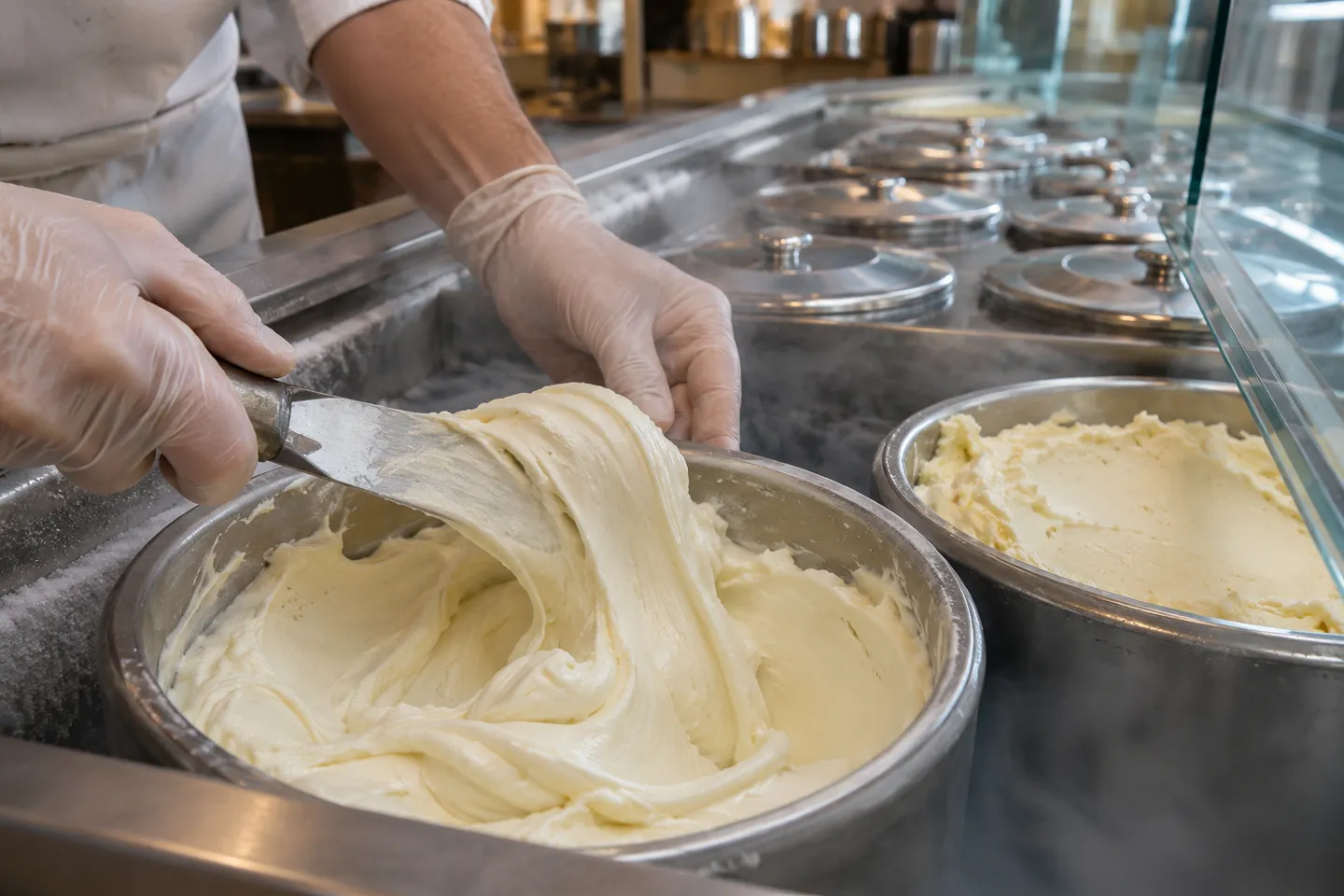
The worked example from gelato practice shows the fork in action. In a 1,000 g milk base, swapping 40 g of sucrose for maltitol left the PAC at 238, unchanged. The same 40 g as sorbitol pushed it to 274, the soft end of the window, while dropping perceptible sweetness by around 9 percent (Free Gelato Balancing, 2026). Same grams, same calorie saving, two different products.
Category by Category: Where Each One Belongs, and Where Each One Fails
Application data backs the fork. Sorbitol usage in chocolate bars is low, while polyols are used heavily in sugar-free hard candy (ScienceDirect, Maltitol overview, accessed 2026). The table below collects the working bands and the failure points that practitioners and the regulatory lines define. Treat the dose columns as starting points for trials, not as approved maxima. The labelling thresholds at the end of this section are the hard lines.
Selection matrix: category x polyol x dose band x failure boundary
| Catégorie | Prefer | Working band | Limite de rupture |
|---|---|---|---|
| Chocolat sans sucre | Maltitol | Sorbitol usage low; maltitol as main bulk polyol | Full replacement leaves sweetness gap; >10% added polyols triggers EU laxative warning |
| Hard candy | Both | Maltitol for sweetness body; sorbitol where cooling and humectancy wanted | Cooking-temperature stability and crystal clarity differ per grade |
| Gelato and ice cream | Sorbitol as texture tool | 3-6% sorbitol; maltitol up to about 8% | Above ~6% sorbitol enters laxation territory; maltitol swap still needs sweetness correction |
| Boulangerie | Maltitol | Sweeping 1:1 for sucrose in dense bakes | Neither polyol browns; missing Maillard colour and flavour must come from elsewhere |
| Chewing-gums et pastilles à la menthe | Both | Sorbitol stronger cooling effect on dissolution | Cooling is a defect in most other categories |
| Pharmaceutical excipients | Maltitol | Per pharmacopoeia grade | Specification and documentation requirements stricter than food grade |
What a Swap Costs Beyond Sweetness
Three second-order effects catch teams that only compared the sweetness table. First, neither polyol is a reducing sugar, so neither participates in Maillard browning (Free Gelato Balancing, 2026). Replace sucrose or dextrose in a bakery or caramel system, and the warm colour and flavour notes disappear with the chemistry. Budget a browning route before the swap, not after. Second, hygroscopicity separates them in the warehouse. Crystalline maltitol is the less hygroscopic of the two and the safer choice for dry blends and humid plants. Sorbitol is markedly hygroscopic, an advantage in soft products and a nuisance everywhere else. Third, sweetness correction has a standard shape: a small dextrose addition, a high-intensity sweetener dosed in parts per million, or both (Free Gelato Balancing, 2026). Sometimes the brief is genuinely both problems at once: sugar down and texture changed. Single-polyol thinking stops working there. The practitioner answer is a polyol blend plus a bulking agent such as inulin or isomalt, which is its own reformulation project.
One line each on the other polyols, so the map is complete. Erythritol brings near-zero calories and the best tolerance but weak bulk. Xylitol matches sucrose sweetness but is famously toxic to dogs. Lactitol is the cheap, low-sweetness filler of the family. Allulose is the emerging low-calorie option that can still brown like sugar (Centre for Food Safety, Hong Kong, 2024; r/CandyMakers, 2024).
The Compliance Check Before Sign-Off
Safety evaluation is settled at the top level. JECFA has evaluated maltitol, maltitol syrup, sorbitol and sorbitol syrup among the ten common polyols (Centre for Food Safety, Hong Kong, 2024). Their acceptable daily intake is set at “not specified”, meaning no health concern at expected use. The working constraints are labelling ones. EU formulas above 10 percent added polyols owe consumers the laxative warning. US formulas owe the equivalent only when foreseeable sorbitol intake passes 50 g per day, the threshold set by 21 CFR 184.1835. A no-sugar-added recipe leaning on polyols for the full sugar load usually crosses that EU line. This is why the compliance read belongs before sign-off, not after the first production run.
Before the spec sheet goes final, pressure-test the supply side: send SAIGAO your category, working band and target market, and get a spec-matched quote back.
Get a Spec-Matched QuoteWhat to Put in the RFQ: Specs, Forms and Documents
Once the selection is made, the risk moves from chemistry to supply. Four steps cover it.
Step 1: fix the form. Crystalline powder, granular or syrup, chosen by process, not by habit. Dry blends and chocolate work favour powder; high-concentration beverage and syrup dosing systems favour liquid. Flowability differs between powder and granular of the same ingredient, and granular generally flows better, which matters on high-speed lines. Note the lead time asymmetry. Powders are commonly held in stock; syrups are frequently produced to order. The liquid form carries a different delivery expectation than the crystal.
Step 2: fix the numbers. Assay or purity, moisture, particle size or mesh, viscosity for syrups, pH, and packaging format. These are the parameters that decide whether the ingredient drops into your existing line or quietly changes it.
Step 3: fix the file list. Demand a certificate of analysis with every batch. Ask for batch traceability back to raw material reports and certificates of origin. Collect the certification set: ISO 22000, ISO 9001, HACCP, Kosher, Halal, non-GMO, and FDA compliance as applicable. Heavy metal and microbiological reports belong in the same file. And for acidic formulations, add shelf-life stability data under acidic conditions. The stability data is the one most often skipped and most expensive to skip; acid systems are where polyol products age differently.
Step 4: audit the supply. Continuous production correlates with batch-to-batch consistency, so ask what the line schedule looks like. Separate the two lead time questions. Stock shipment covers standard grades; custom production covers adjusted specs. The custom path runs in weeks, commonly quoted at 20 to 30 days. Confirm free samples for lab trials. Then ask which parameters are actually negotiable; viscosity, particle size, purity, water activity and packaging are the dimensions serious suppliers will discuss (SAIGAO, 2026).
RFQ checklist
- 1
Formulaire
- Crystal, granular or syrup, matched to process
- 2
Spec numbers
- Assay or purity
- Humidité
- Particle size or mesh
- Viscosity for syrups
- pH
- Packaging format
- 3
File list
- COA with every batch
- Batch traceability back to raw material reports and certificates of origin
- Certification set: ISO 22000, ISO 9001, HACCP, Kosher, Halal, non-GMO, FDA as applicable
- Heavy metal and microbiological reports
- Shelf-life stability data under acidic conditions
- 4
Supply audit
- Line schedule and continuous-production consistency
- Stock vs custom lead times, asked separately
- Free samples for lab trials
- Customization dimensions: viscosity, particle size, purity, water activity, packaging
What This Means for Your Sourcing Strategy
Fold the chain back up and one sentence survives. The size difference between two hydrogenated sugars decides metabolism, texture behaviour, dose ceilings and labelling. Maltitol and sorbitol are two different tools, not two quotes for the same tool. In the mainstream sugar-reduction categories, chocolate, bakery and most sugar-free confectionery, the selection lands on maltitol more often than not. It replaces sucrose without asking for a texture rebuild. Sorbitol stays in its niche as a deliberate softening and humectancy tool.
That conclusion changes what a buyer should actually evaluate. When maltitol wins the formula, the supply risks to manage are concrete. Does the supplier hold both crystal and syrup forms? Can they hold batch consistency across a line that runs continuously? Will the file list arrive complete with every shipment? When a formula genuinely needs sorbitol, the budget line to accept is narrower. Budget for a 3 to 6 percent working band and the labelling obligations that come with polyol-heavy recipes. Distributors carrying both should stock them as the different tools they are. Maltitol is the volume line, so it deserves full form coverage. Sorbitol is the niche line, so it runs on leaner inventory. And where a range needs bulking fibre alongside the polyol, converging those items on the same supplier review shortens the audit trail.

The next step is mechanical: send the four-step list from the RFQ section to two or three suppliers and compare answers parameter by parameter. When we are the ones under review: SAIGAO’s maltitol line covers both crystalline powder and syrup forms. The same line carries eight customization dimensions, from viscosity and particle size through purity, pH, water activity and packaging (Caractéristiques techniques du maltitol en poudre et en sirop). We hold stock grades for week-level shipment and run custom specs on a 20 to 30 day schedule, with batch documentation included.
Start Your Maltitol or Sorbitol RFQ
Crystalline powder and syrup forms, stock grades for week-level shipment, custom specs on a 20 to 30 day schedule, batch documentation included.
Send Your RFQ to SAIGAORéférences
- Msomi, N. Z. et al. “Suitability of sugar alcohols as antidiabetic supplements: A review.” 2021. pmc.ncbi.nlm.nih.gov
- Saraiva, A. et al. “Maltitol: Analytical Determination Methods, Applications in the Food Industry.” 2020. pmc.ncbi.nlm.nih.gov
- Centre for Food Safety, Hong Kong. “Sugar Alcohols: An Overview.” 2024. cfs.gov.hk
- eCFR. “21 CFR 184.1835 Sorbitol.” ecfr.gov
- Regulation (EU) No 1169/2011 on food information provided to consumers. 2011. eur-lex.europa.eu
- Beltrá, M. et al. “Nutritional Description of Foods with Low- and No-Calorie Sweeteners.” 2022. pmc.ncbi.nlm.nih.gov
- Free Gelato Balancing. “Maltitol vs Sorbitol in Gelato: Which Polyol to Use.” 2026. freegelatobalancing.app
- ScienceDirect. “Maltitol: An Overview.” Accessed 2026. sciencedirect.com
- r/keto. “Just discovered the wonders of maltitol. NEVER AGAIN!” 2020. reddit.com
- r/CandyMakers. “MUST sugar free candy use laxatives like sorbitol or maltitol?” 2024. reddit.com
 English
 Russian
 Spanish
 French
 Arabic