
Two Rare Sugars, One Tiny Difference
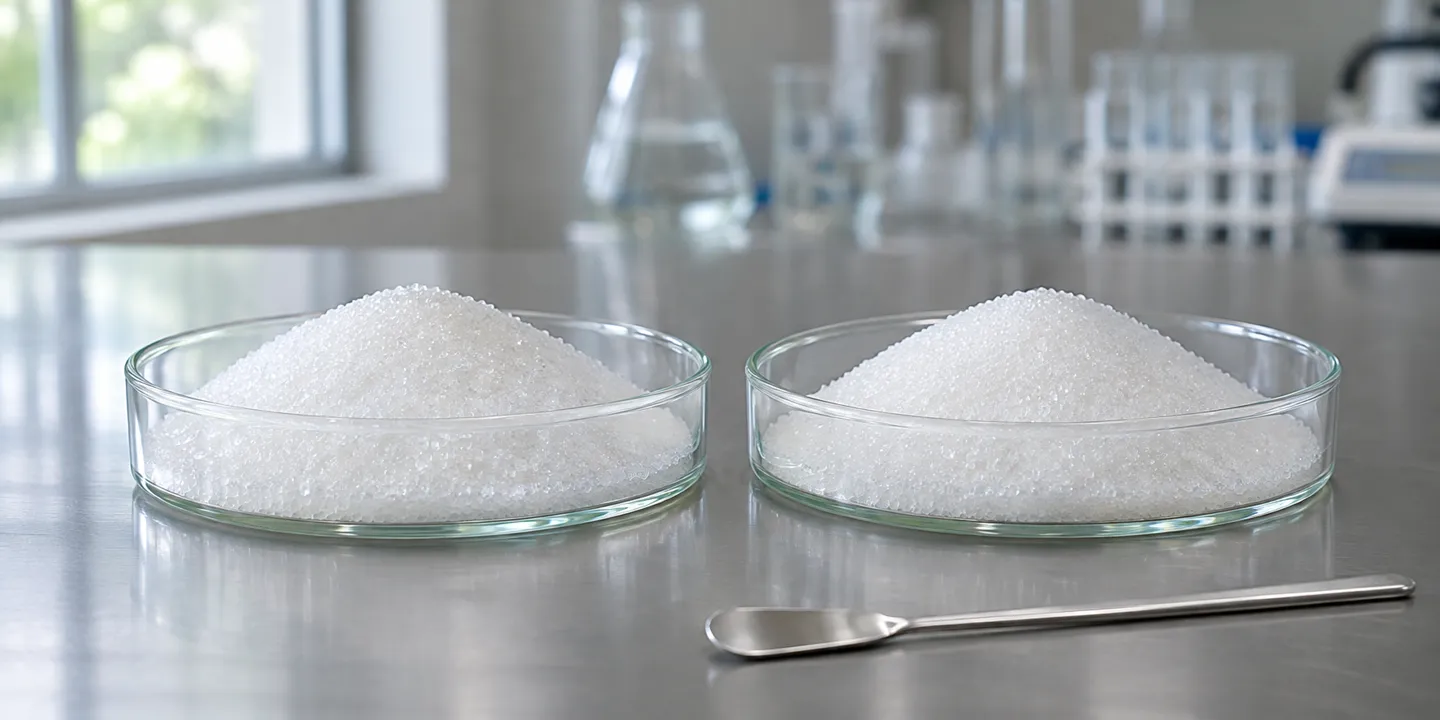
Two white powders sit on almost every sugar-reduction bench right now, and at first glance they are hard to tell apart. Both pour like sugar. Both taste like sugar: a sensory panel will rate tagatose the closest match to sucrose most people have tried, with allulose close behind. Neither one acts like sugar once it is swallowed.
They are rare sugars, and rare is the honest word. Tagatose occurs naturally in heated dairy and in trace amounts in some fruits. It makes up less than 0.2% of the sugars in those sources, so factories make it rather than extract it. Allulose sits in the same position: small traces in figs and raisins, nothing you could ever harvest at commercial scale (Tufts Now, 2025).
Chemistry puts the two in the same family. Both are epimers of fructose, which means each differs from fructose, and from the other, at exactly one carbon position. Two naming notes will save you confusion downstream. Allulose still appears under its older name, D-psicose, on some certificates of analysis; do not confuse it with allose, a different rare sugar altogether. Tagatose entered commercial production through dairy chemistry, since processors break lactose down into galactose and then isomerize it into tagatose. Both hold GRAS status in the United States, which is why both can legally sit in your formulation.
That one molecular position is the whole story here. The single-carbon difference changes what your body does with each sugar. It then changes how each behaves in a mixer or an oven. It changed what regulators let you print on the label, and it now sets the price gap between them. The next four sections follow that cascade one layer at a time, and you can stop at the layer your job needs.
What Each Sugar Does Inside the Body
What happens after swallowing decides three things at once. It decides how many calories the sugar contributes. It decides what happens to blood glucose. And it decides how much a person can eat before their stomach files a complaint. This is where the two sugars split for the first time.
Allulose mostly passes through you. Roughly 70-80% of ingested allulose is absorbed in the small intestine and excreted unchanged through the kidneys, barely metabolized at all (Osborn et al., American Journal of Clinical Nutrition, 2026). That metabolic dead end is why the FDA credits it with 0.4 calories per gram. Tagatose takes the opposite route: only about 20-25% is absorbed in the small intestine, and the rest travels to the colon, where gut bacteria ferment it. That fermentation produces short-chain fatty acids, which is where tagatose gets its prebiotic reputation, and it is also where the gas comes from.
The clinical record now has scale behind it. A 2026 meta-analysis in the American Journal of Clinical Nutrition pooled 20 controlled trials with 1,033 participants (Osborn et al., American Journal of Clinical Nutrition, 2026). Both rare sugars significantly blunted postprandial glucose and insulin responses across those trials. Tagatose showed the stronger acute effect on glucose. It also produced a modest reduction in HbA1c and fasting insulin, though the authors flag that second finding as low-certainty evidence. Set expectations honestly. Neither sugar moved blood lipids, body weight, or body composition in any pooled analysis. The review found no significant effect on uric acid either, despite a caution that circulates in some forums. These are blood-sugar tools, not weight-loss tools.
Tolerance is the other boundary. Formulator guidance puts tagatose at roughly 30 g per single serving before digestive discomfort becomes likely (Icon Foods, 2025). Allulose is generally tolerated at higher single servings, with published figures up to around 50 g.
| Attribute | Tagatosa | Alulosa |
|---|---|---|
| Absorption and fate | 20-25% absorbed in small intestine; remainder fermented in colon | 70-80% absorbed, excreted unchanged via kidneys |
| Calories per gram (FDA-recognized) | 1.5 kcal/g | 0,4 kcal/g |
| Postprandial glucose response | Blunted; strongest acute effect in pooled trials | Blunted; moderate certainty |
| Long-term effects | Modest HbA1c and fasting insulin signal, low certainty | No significant pooled effects |
| Practical single-serving tolerance | ~30 g before GI distress becomes likely | Higher; figures up to ~50 g reported |
For a household shopper, the takeaway fits in one line. Allulose is easier on calories and easier on the gut. Tagatose tastes the most like sugar. Dose decides whether either one agrees with you.
Tolerance boundary
Start low, around 10-15 g, and step up. Tagatose sits near a 30 g single-serving ceiling before GI distress becomes likely; allulose is generally tolerated higher. Exact thresholds vary across studies and across people.
How They Behave in the Formula
Inside the body the differences are measured in percentages. On the bench they decide whether a cookie browns, whether a gummy holds its shape, and whether a syrup stays clear on the shelf. Formulators who pick a rare sugar on metabolic data alone usually discover the real differences here.
Sweetness comes first, because it sets the math for every other decision. Tagatose delivers about 92% of sucrose sweetness, close enough to swap almost one for one. Allulose delivers about 70%, which means a full replacement needs either more grams or a high-intensity partner (Icon Foods, 2025). Allulose gives a clean sweet onset and a short finish with no cooling sensation. Tagatose tastes very close to table sugar, with a faint cooling note some palates pick up.
⭐ Browning and the Maillard Reaction
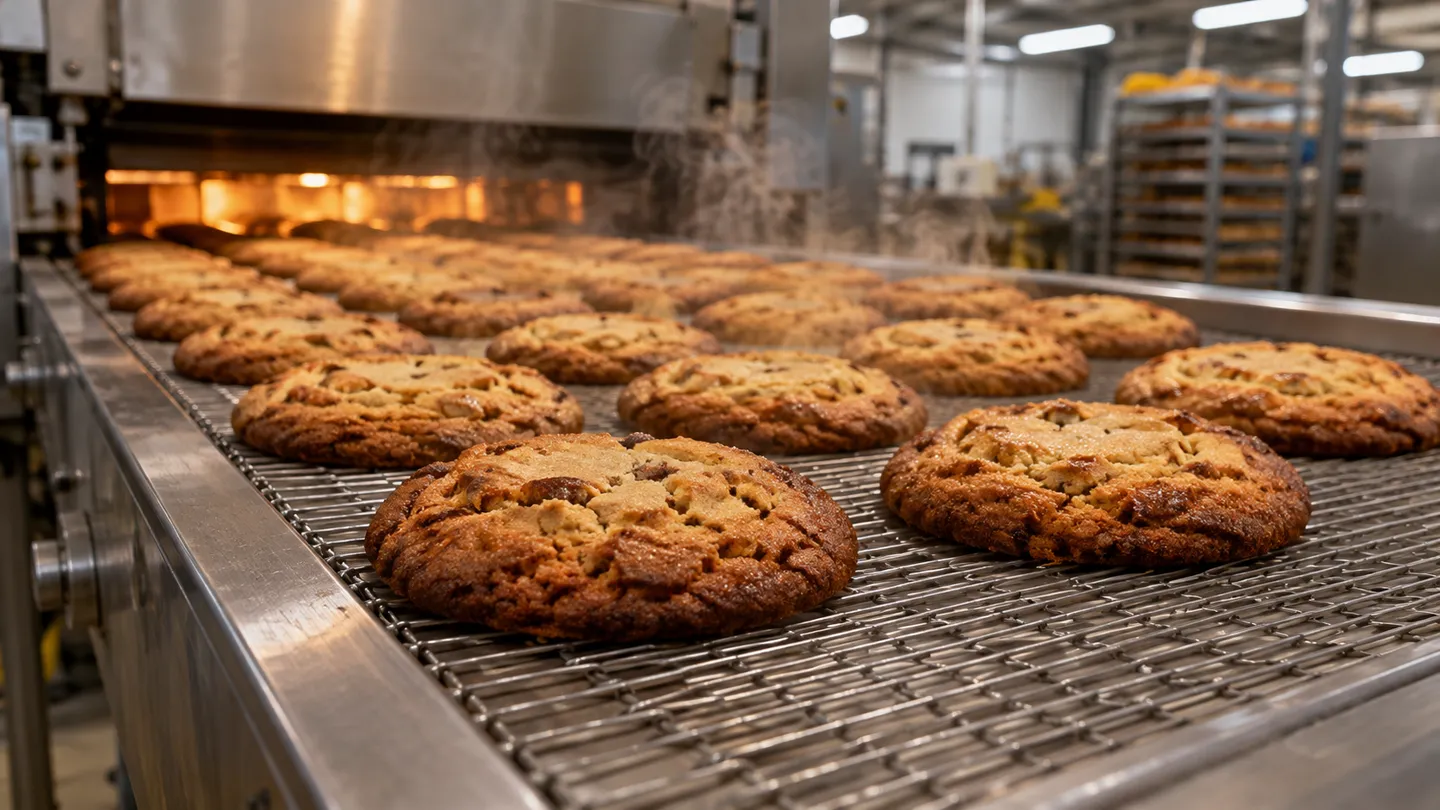
Tagatose is a reducing sugar, and it browns the way sucrose does (AgFunderNews, 2026). Cookies take on color. Glazes caramelize. Baked goods develop the toasted notes consumers expect from “real” sugar. Allulose browns only mildly, so an allulose-led bakery recipe usually needs a browning partner. That partner can be a slice of tagatose, a polyol blend, or process adjustments like a longer bake or a finishing step. The boundary runs the other way too. In high-moisture systems, tagatose can brown faster than you want. Lock oven temperature and bake time before production, not after the first scorched run.
Crystallization, Texture, and Moisture
Tagatose crystallizes readily and ships as a free-flowing powder, which is exactly what confectionery and tableted formats want (AgFunderNews, 2026). Industry distribution partners describe it as easy-handling precisely because it stays free-flowing in storage. Allulose behaves almost in mirror image. It is more soluble, it does not recrystallize, and it holds moisture. That keeps syrups, fillings, and caramels smooth. It also means a bulk bag left open will pick up water. One published comparison actually ranks the two differently on hygroscopicity, so before committing a shelf-life claim, run a storage test with your own packaging. In frozen desserts, tagatose depresses the freezing point more strongly and produces noticeably softer scoops. Allulose depresses it moderately and often needs a fiber or polyol alongside it to carry texture.
Blending Strategy
The industry consensus, shared by suppliers on both sides of the Atlantic, is that the best systems use both rare sugars rather than choosing one (Icon Foods, 2025). A workable pattern has three moves. Pick the base sugar from your label target. Close the sweetness gap with a high-intensity sweetener such as stevia, monk fruit, or sucralose. Then fix texture with the tools from the previous section. An allulose base plus stevia covers “zero sugar, zero fuss” beverages. A tagatose inclusion rescues browning and body in baked lines. Erythritol or soluble fiber can carry bulk where calories need to stay flat. Every added component adds cost and a longer ingredient statement, so the blend is a negotiation, not a default.
The matrix below condenses the bench decisions. Read it as “my application, my default, and the point where I should switch plans.”
| Sistema de solicitud | Better default | ¿Por qué? | Switch or blend when |
|---|---|---|---|
| Baked goods needing color (cookies, glazes, sauces) | Tagatose lead | Reducing sugar, browns like sucrose | Allulose-only recipes need a browning partner or process change |
| Beverages and syrups | Allulose lead | Dissolves fast, no recrystallization, clean taste | Watch moisture pickup in storage; tagatose in hot-fill needs browning control |
| Confectionery and tablets | Tagatose lead | Crystallizes readily, free-flowing, sucrose-like body | Allulose tends toward softness and moisture pickup |
| Ice cream and frozen desserts | Either; tagatose softer | Stronger freezing point depression gives softer scoops | Allulose-heavy bases need fiber/polyol for texture |
| Tabletop and home use | Alulosa | Higher tolerance, lowest calories, clean taste | Tagatose suits browning-minded home bakers |
System selection ends up running label target first, texture second, and unit price last, which is convenient, because the next two sections walk up that exact ladder.
Send SAIGAO your application and target claim, and we will match crystal or syrup allulose and tagatose specs to the line you are building.
Get a spec-matched quoteThe Label Math: What Each Sugar Can Claim Now
For years, the label was the sharpest line between the two sugars. How that line moved explains where the market stands today.
Allulose got its green light first. FDA issued draft guidance in 2019 and finalized it in October 2020 (FDA, 2020). Manufacturers may exclude allulose from both the Total Sugars and Added Sugars lines. They count it at 0.4 calories per gram, and they must still declare it inside Total Carbohydrate. Tagatose’s path to the same place was anything but smooth. FDA denied the first petition in 2022. A court overturned that decision in 2024 as arbitrary and capricious. Finally, the agency put its position in writing: a letter dated November 21, 2025, published in April 2026 (FDA, 2025). It grants enforcement discretion to exclude D-tagatose from the Added Sugars and Total Sugars declarations. It counts tagatose at 1.5 calories per gram. And it confirms tagatose’s eligibility for the noncariogenic dental health claim.
Run the label math on an identical 10 g sweetening system. Both sugars now read the same sugar lines: 0 g total sugars, 0 g added sugars, both declared inside total carbohydrate. The calories line is where they part: about 4 kcal for the allulose version against 15 kcal for the tagatose version. The label difference has collapsed to a calorie row and a paper trail.
That paper trail is the point worth remembering. Allulose’s label green light came in 2019 and was finalized in October 2020; tagatose waited until November 2025 for the same one. The road between ran through a denied petition and a court ruling that called the FDA’s refusal arbitrary and capricious. Six years of label eligibility, plus the supplier network that grew up around it, is a head start no letter can hand over overnight.
Two green lights, six years apart
Both sugars are now excluded from the Total Sugars and Added Sugars lines. Both stay declared inside Total Carbohydrate.
Alulosa
Final guidance, Oct 2020
Draft guidance 2019, finalized Oct 2020.
0,4 kcal/g
Six years of label history and a supplier network built on it.
Tagatosa
FDA letter, Nov 21 2025
Published Apr 2026; petition denied 2022, court overturned 2024.
1.5 kcal/g
Eligible for the noncariogenic dental health claim.
Same 10 g sweetening system: 4 kcal allulose vs 15 kcal tagatose.
One more boundary matters, and it points the other direction. In the European Union the list flips. Tagatose holds novel food approval and has been usable there for years. Allulose has not been authorized, and EFSA concluded in 2025 that it could not establish D-allulose’s safety from the available data (EFSA, 2025). Before a single formulation decision, confirm which market you are feeding. US rules make both sugars claimable. EU rules currently make tagatose the rare sugar of record. And treat the US exemptions as enforcement discretion rather than finished regulation. The agency is still working through a broader framework for sugars metabolized differently. Check the current guidance before finalizing a claim.
Cost, Supply, and How to Buy
Label eligibility answers whether you can make the claim. The next question is the one procurement actually lives in. What does the sugar cost, can you get it at volume, and what goes on the purchase order? Work through the questions in that order; the sequence saves money.
Where the Cost Comes From
The price gap has a manufacturing explanation. Allulose rides on the corn wet-milling economy: producers isomerize abundant fructose streams, share feedstock with a mature industry, and run at a scale that keeps pricing comparatively flat. Tagatose still mostly starts from lactose, breaks it into galactose, and isomerizes from there. Conventional routes convert only 40-77% of feedstock into product, which is the root of the premium (Tufts Now, 2025). The cost structure is not fixed, though. A biosynthetic route announced in December 2025 converts glucose to tagatose with yields up to 95%, roughly a quarter more feedstock efficiency than the conventional range. The process owner is now paired with a global distributor and a major European ingredient company to scale it.

Price Today and Direction Tomorrow
Start with current tagatose pricing, from a July 2026 industry price guide (BSH Ingredients, 2026). Standard food-grade lots in metric-ton quantities run near USD 10 per kilogram. Large-volume contracts in the 50-ton-plus range reach USD 8-9 per kilogram. Both bands sit well below the USD 13-15 per kilogram common two to three years ago. Demand moved at the same time. Inquiries from US, Canadian, and European buyers picked up measurably after the FDA letter went public in April 2026. The US market led, because the labeling door just opened there. Supply is scaling to meet it, but new capacity takes the form of announced expansions and cooperation agreements, not tonnes sitting in warehouses today.
Tagatose wholesale price bands, July 2026
$10/kg
Standard food-grade lots, metric-ton quantities
$8-9/kg
Large-volume contracts, 50 t and above
$13-15/kg
Common band two to three years ago
Wholesale bands from a July 2026 industry price guide; pricing is volume-linked.
Put those curves together and a judgment falls out for the next one to two years. The tagatose-allulose price spread will most likely keep narrowing. Tagatose supply stays tight, though, until the announced capacity actually lands. The failure condition for that judgment is written into it: if the biosynthesis and expansion projects stall at pilot scale, the spread persists and nothing is lost by waiting. Allulose pricing has less exposure either way, since its supply base is already wide.
What to Put in the RFQ
Whatever the sugar, the specification sheet is where a good price turns into a usable ingredient. Ask for these, in this order of importance:
| RFQ item | What to ask for |
|---|---|
| Purity / assay | 98% vs 99% tiers; pharma-adjacent uses pay a premium for 99% |
| Formulario | Crystal or syrup; syrup solids commonly 70%+ |
| Particle size / mesh | Match to your dissolution and blending equipment |
| Moisture and water activity | Critical for shelf-life claims, especially with allulose |
| Micro and heavy metal limits | Per-batch COA, not a generic certificate |
| Certifications | ISO 22000, HACCP, Kosher, Halal, Non-GMO, per your target market |
| Traceability | Lot-level traceability from raw material to delivery |
| MOQ and samples | Sample policy first, then pilot quantity, then bulk terms |
Then qualify in the order distributors actually use.
From sample to contract, in three steps
Ejemplo
100-500 g for lab verification
Plant trial
1-2 bags in your real matrix
Volume contract
Terms only after the pilot passes
Skip the pilot step and the quote gets paid for twice.
What This Means for Your Sweetener Business
Reread everything above through a stocking decision and the picture simplifies. Label eligibility has converged. Both rare sugars can carry a “0 g added sugars” story on a US panel, so the claim no longer picks the winner. What still separates them is what the letter could not change. Allulose has six years of label history, a scaled supply base, and the lowest calorie number in the category. That profile is the volume line for any portfolio aimed at US-label products. Tagatose holds the freshest eligibility and the closest match to sugar’s taste and browning. Its price is falling from USD 13-15 toward USD 8-10 while supply stays tight. That profile is a margin line, not a volume line.
The stocking logic follows. Hold allulose deep as the base. Position tagatose as the differentiated line for formulation-driven customers. Lock tagatose volume and pricing before the announced capacity lands. The spread that makes it a margin story today is the same spread the capacity will compress tomorrow. On the sales floor, the conversation that closes orders is rarely about sweetness percentages. It is the conversation where you hand a downstream brand its own numbers. The sugar lines both read zero. The calorie line reads 4 versus 15. The market list says tagatose for the EU build, either sugar for the US build.
All of that assumes the portfolio is aimed at the US label. For customers selling into the EU, the same logic points at tagatose alone until allulose’s status changes. Every claim conversation should start by confirming the destination market’s current rules. Enforcement discretion is a policy direction, not a finished code.
Stocking either line starts with a supplier who runs the scaled path daily. SAIGAO has produced allulose in China longer than most. The range covers crystal and syrup allulose forms with a near-colorless crystal, plus customizable grain size, color, and sweetness profile. Everything is manufactured on automated lines under ISO 22000, HACCP, Kosher, Halal, and Non-GMO certifications. In-stock orders ship in 7 days and custom lots in 20-30 days. We will match spec sheets to your downstream claim targets before the first quote goes out.
Put both rare sugars on one spec sheet
Crystal and syrup allulose from long-running automated lines, tagatose for EU-bound builds: your spec sheet is matched to your claim targets before the first quote, and in-stock orders ship in 7 days.
Request a QuoteReferencias
- U.S. Food and Drug Administration. “Response to Bonumose: Labeling of D-tagatose on the Nutrition Facts Label.” 2025. fda.gov
- U.S. Food and Drug Administration. “FDA Seeks Input on Nutrition Labeling for Certain Sugars and Issues Final Guidance on Allulose.” 2020. fda.gov
- Osborn, L. et al. “Glycemic and Cardiometabolic Effects of Rare Sugars Allulose and Tagatose: A Systematic Review and Meta-analysis of Controlled Human Intervention Trials.” American Journal of Clinical Nutrition. 2026. pubmed.ncbi.nlm.nih.gov
- Tufts Now. “Researchers Develop Way to Make Healthier Sugar Substitute.” 2025. now.tufts.edu
- AgFunderNews. “FDA Exempts Low-GI Sweetener Tagatose from Added Sugar Labeling.” 2026. agfundernews.com
- European Food Safety Authority. “Safety of D-allulose as a Novel Food Pursuant to Regulation (EU) 2015/2283.” EFSA Journal. 2025. efsa.onlinelibrary.wiley.com
 English
 Russian
 Spanish
 French
 Arabic