
The ingredient list on the back of a sugar-free gum pack usually starts with sorbitol. Xylitol often appears further down, sometimes with a proud little line about tooth health next to it. Both are sugar alcohols, both replace sugar, and the order they appear in has little to do with which one is “better”. It reflects a decision the manufacturer made about sweetness, moisture, cost and label claims. The same decision is waiting for anyone formulating a candy, a syrup, a tablet or a pet-safe product line.
This article follows one comparison from your body to your buying desk. First the molecules themselves, then what each does in the human body, then how each behaves in a product, then how to choose by category. Last come the cost math and the verification checklist that decide what you actually order.
Two Molecules, One Family: What Sorbitol and Xylitol Actually Are
Despite the name, sugar alcohol contains no ethanol. Nothing in a sugar-free mint can intoxicate you, so nobody is “drinking” sugar alcohol by chewing gum. Sorbitol and xylitol are two different molecules inside the same family of polyols. Polyols are carbohydrates whose hydroxyl groups make them taste sweet without fermenting in your mouth the way sugar does.
Sorbitol is a six-carbon sugar alcohol, formula C6H14O6. Industry makes it by taking glucose from corn or wheat starch and running it through catalytic hydrogenation. Xylitol is a five-carbon molecule, formula C5H12O5, and its feedstock route is different. Xylose is extracted from xylan-rich biomass such as corn cobs or birch wood, then hydrogenated (Элхемия, 2025). That structural and feedstock difference is the root of every other difference in this article, from laxation thresholds to price.
The family is bigger than these two. Erythritol (four carbons), maltitol, lactitol, isomalt and mannitol (six-carbon and longer) fill out the polyol map, and each has its own tolerance profile and price tag. If you arrived here from a gum wrapper, this two-molecule comparison is the most common crossroads, and the family map above is enough context for everything that follows.
One more clarification before the comparison gets physical: both molecules are marketed as “natural”, and both are industrial products. Sorbitol occurs in stone fruits, xylitol occurs in fruits and vegetables, and the human body produces small amounts of both during normal metabolism. The white powder in a drum, though, comes from hydrogenation, not from pressing fruit. Judge them as processed ingredients, because that is what they are.
Inside the Body: Blood Sugar, Tolerance, Teeth and Pet Safety
Most people arrive at this comparison through one of four worries: blood sugar, an upset stomach, a cavity-prevention claim, or a dog that just found the sugar-free candy. Each has a clear answer.
Body-level differences at a glance
| Размер | Сорбит | Ксилит |
|---|---|---|
| Калории | ~2.6 kcal/g | ~2,4 ккал/г |
| Гликемический индекс | ~9 | ~7 to 12 across studies |
| Laxation threshold | warning threshold from 10 g in medicinal products | tolerated around 20 g per dose in liquid-form studies |
| Стоматологический эффект | non-cariogenic (bacteria cannot ferment it) | non-cariogenic plus active anti-S. mutans mechanism |
| Dogs | generally tolerated | toxic, emergency-level risk |
Source: Элхемия, 2025; Atkinson et al., 2021.
On blood sugar, both are friendly. Their glycemic index values sit in the low single or low double digits against roughly 65 for table sugar. That is why both appear in diabetic-friendly and reduced-sugar lines (Atkinson et al., 2021). The calorie difference, 2.6 versus 2.4 kcal/g, is real but small next to sugar’s 4 (Элхемия, 2025).
Tolerance is where the honest answer gets messy, because there is no single safe dose for either molecule. Sorbitol is the sensitive one. Guidance for medicinal products treats 10 g as the threshold that justifies a laxative warning (EMA, 2017). Review literature puts strong laxative effects above roughly 20 g per day for many adults (Dragomir et al., 2025). Xylitol tolerates more: a controlled liquid-form study found intake up to about 20 g per single dose manageable, with daily intakes tested toward 60 g (Storey et al., 2007). Individual variation is wide, so a person who bloats after two sticks of gum is not imagining it, and a person who tolerates a handful of mints is not immune. What regulators actually do is label-based. In the EU, any food with more than 10% added polyols must carry the statement “excessive consumption may produce laxative effects” (Регламент (ЕС) № 1169/2011, приложение III). That warning is a threshold mechanism, not a safety verdict, and it applies to both molecules.
Teeth are where the two genuinely separate. Both are non-cariogenic, because oral bacteria cannot ferment either into the acid that erodes enamel. Xylitol goes further. Streptococcus mutans takes it up through its own transport pathways, and the molecule then disrupts the bacterium’s energy cycle instead of feeding it (NiranBio, 2026). That mechanism is specific to the five-carbon structure, and sorbitol cannot replicate it. Marketing has run far ahead of this mechanism, though. Claims about reversing cavities or eliminating 90% of acid-producing bacteria circulate widely. Meanwhile, a systematic review of clinical trials judged the evidence that xylitol outperforms sorbitol as contradictory and at high risk of bias (Mickenautsch, 2020). The defensible position sits between the poster and the skeptic. The mechanism is real, and the net clinical effect over brushing and fluoride is modest. The formal label claim, where one exists, is narrower than the marketing.
The one hard rule in this comparison
Dog owners and pet-product formulators: xylitol is toxic to dogs, and the FDA treats even small amounts as an emergency. In dogs, xylitol triggers a rapid insulin release followed by dangerously low blood sugar and possible liver failure. Sorbitol does not carry this risk and appears in some pet foods. Any product line a dog might reach, treats, baked goods, peanut butter spreads, must keep xylitol out entirely. (FDA, 2025)
Worth one sentence of context: erythritol, the third polyol people cross-shop here, went through its own trust shock in 2024 over cardiovascular-association research. Category reputation moves, and it moves fast, which is one more reason to buy on verifiable specs rather than headlines.
Inside the Product: Sweetness Physics, Moisture and Process Pitfalls
The same 5 g of polyol that disappears into your tea without incident can cause real trouble inside a candy batch, and the difference is physics, not your digestion. Formulators care about four properties of these molecules: sweetness intensity, cooling effect, moisture behavior and physical form. Each one changes what the molecule can do on a production line.
Sweetness and Cooling: How Much You Actually Need
Xylitol matches sucrose at a 1:1 weight ratio, so a recipe converts without recalculating anything. Sorbitol delivers about 60% of sucrose sweetness, which means a formulator needs roughly 1.6 to 1.7 times the weight to hit the same sweetness. That extra bulk changes texture, water activity and calories (Элхемия, 2025).
Cooling is the underrated sensory variable. Dissolving xylitol absorbs about 36.6 J/g of heat, noticeably more than sorbitol’s 26.8 J/g (NiranBio, 2026). That endothermic dip is the cold, clean sensation in mint gum and breath strips. In mint formats it is a feature you formulate around. In bakery or dairy it is a defect. The fix is masking (fat and cocoa both dampen it), or switching the bulk polyol and reserving xylitol for the surface dusting, where its coolness reads as freshness.
The 65% Humidity Line: Moisture Behavior and Caking
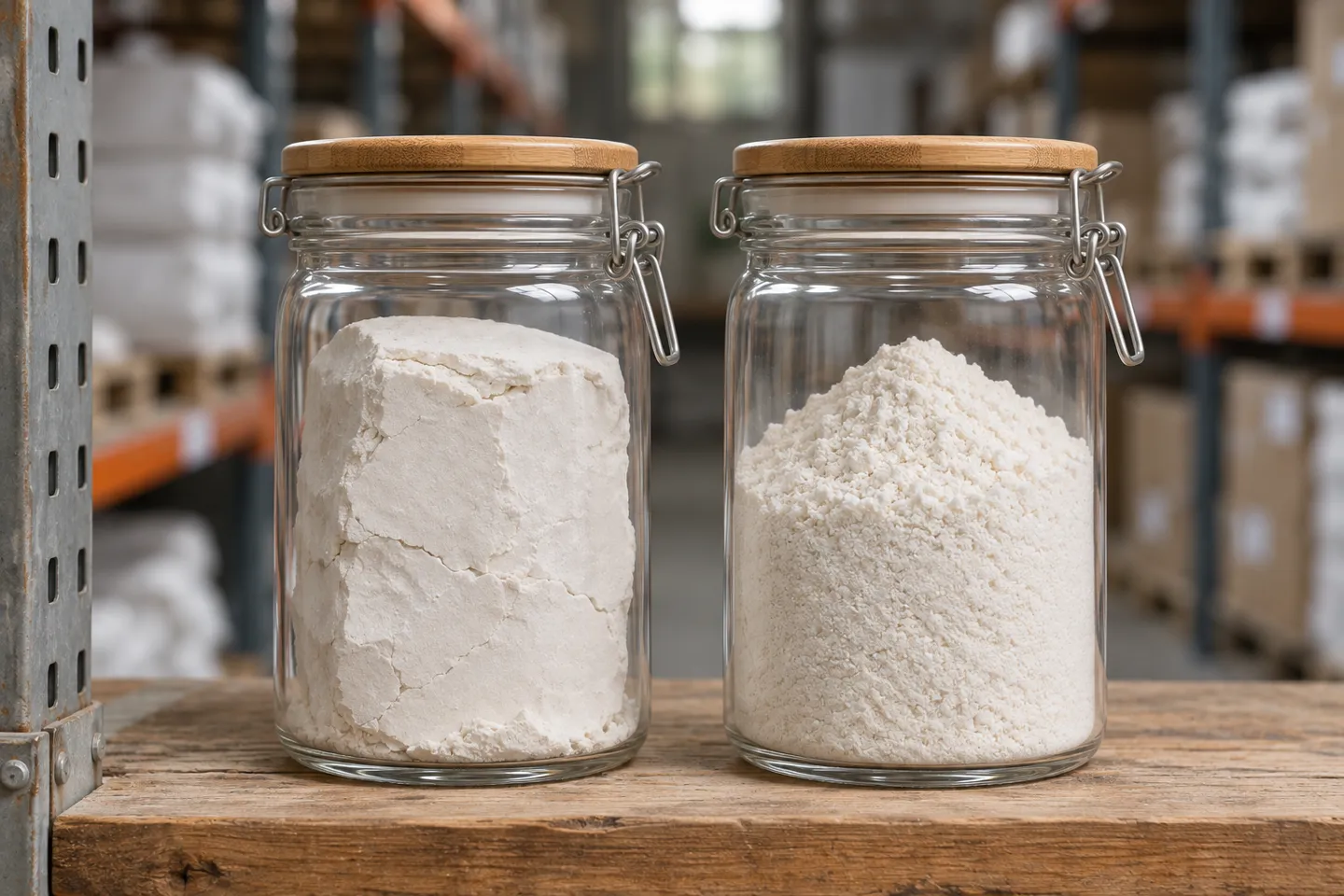
Sorbitol is strongly hygroscopic, which is exactly why soft candies and baked goods keep their moisture with it, and exactly why its powder form causes trouble. Above roughly 65% relative humidity, sorbitol powder starts pulling moisture and caking. Storage and packaging therefore need real barrier properties, not just a poly bag (NiranBio, 2026). Xylitol powder is far more stable in ambient conditions and flows better in dry blending. It holds its crystal structure on the shelf, a quiet advantage in tablet compression and dry mixes (NiranBio, 2026).
Before you order: confirm your warehouse humidity profile, and demand the packaging barrier spec in writing.
If a “cheap sorbitol powder” order arrives clumped in humid season, that is the failure mode in action, not a supplier scam.
Crystal Powder vs 70% Liquid: What Each Form Asks of Your Line
Form availability splits the two molecules cleanly. Sorbitol ships as crystalline powder and as a 70% aqueous solution. That liquid integrates straight into continuous syrup and beverage lines, builds viscosity and suppresses crystallization in jams and gels (NiranBio, 2026). Xylitol exists as crystal powder only, which suits dry mixing, direct compression and confectionery surfaces (NiranBio, 2026). Melting behavior sits close together, xylitol around 92 to 96 °C and crystalline sorbitol around 95 to 97 °C (Xylitol, Wikipedia; APACSS, 2026). Lozenges and pressed tablets therefore treat them almost interchangeably in the press.
Physical behavior at a glance
| Недвижимость | Сорбит | Ксилит |
|---|---|---|
| Сладость против сахарозы | ~60% | ~100% |
| Cooling effect | −26.8 J/g | −36.6 J/g |
| Hygroscopicity | high (caking above ~65% RH) | low to moderate |
| Physical forms | powder + 70% liquid | crystalline powder only |
| Melting range | ~95-97 °C | ~92-96 °C |
| Best-fit line | syrups, beverages, soft candy | dry mix, direct compression, gum dusting |
One process pitfall deserves its own flag. In syrup systems, xylitol can recrystallize where sorbitol would have stayed in solution. Confectioners blending the two therefore let the sorbitol base carry the moisture, and the xylitol carry sweetness and label value. Get that ratio wrong and you find sand in the gummy, not on the spec sheet.
Choosing by Product Category: Where Each Polyol Earns Its Place
Asking “which is better” is the wrong question, because the honest answer is “for what”. A category table settles it faster than a debate.
Category fit and switch boundaries
| Приложение | Recommended choice | Why | When to switch |
|---|---|---|---|
| Chewing gum, mints, oral lozenges | xylitol-led (often 100% xylitol-sweetened) | sucrose-level sweetness, active dental claim eligibility, cooling synergy | Switch when a cost ceiling blocks the claim and a non-cariogenic-only label is acceptable |
| Soft candy, gummies | sorbitol base + xylitol accent | humectant bulk with a sweet, claim-bearing top note | Switch to all-xylitol only if moisture pickup must be minimal |
| Bakery, baked fillings | sorbitol-led | moisture retention and heat stability at bulk cost | Switch if cooling perception becomes a defect risk, mask or reformulate |
| Syrups, suspensions, pharma bases | sorbitol 70% liquid | line-ready viscosity, crystallization control | Keep sorbitol here, xylitol powder has no liquid equivalent |
| Напитки | sorbitol solution or family blends | bulk sweetness at workable cost and viscosity | Xylitol reserved for premium, dental-positioned formats |
| Pet-adjacent products (treats, spreads) | sorbitol or erythritol only | xylitol is a hard exclusion | Never switch to xylitol, ever |
Two structural notes sit behind that table. First, blending is the industry’s default answer in confectionery and oral care: sorbitol carries moisture and bulk cost, xylitol carries sweetness and the claim. The ratio is not a taste guess; it is back-calculated from two numbers. One is the sweetness gap: how much xylitol the recipe needs. The other is the claim threshold: how much xylitol the target market’s rules require, for example gums sweetened solely with xylitol. Second, the demand side is not a fad. Grand View Research sizes the polyol sweeteners market at USD 7.1 billion in 2025, heading to USD 11.9 billion by 2033 at a 6.6% CAGR (Grand View Research, 2025). Growth is pulled by sugar-reduction targets and by oral-care positioning.
The claim itself is the quiet dividing line between the two molecules. In the EU, one authorized health claim reads: “sugar-free chewing gum contributes to the maintenance of tooth mineralization” (Regulation (EU) No 432/2012). It may be used only for gum sweetened solely with xylitol. The condition of use: chewed at least 20 minutes after eating or drinking. Sorbitol cannot carry that sentence on a pack, in any blend ratio. A formulator who needs the claim has already chosen xylitol; a formulator who only needs moisture and bulk is paying premium for nothing. That is also the boundary of blending: it wins when the two roles are both real. It loses when the recipe’s sweetness gap is so large that no reasonable ratio closes it, which means the problem is the sweetener system, not the blend.
Buying Right: Cost-per-Sweetness Math and Supplier Verification
The price gap between the two molecules is the largest of all their differences, and it is the one most often misread. Industry-wide per-kilogram quotes put xylitol at roughly 3 to 5 times the price of sorbitol (NiranBio, 2026). That number reliably triggers one of two bad decisions: rejecting xylitol outright, or paying it blindly for a “premium” badge. Both skip the arithmetic that actually matters.
The Only Fair Comparison: Cost per Equal Sweetness
If sorbitol delivers 60% of sucrose sweetness, matching xylitol’s sweetness takes about 1.6 to 1.7 times the sorbitol weight. Run that through the price gap and the 3 to 5 times headline narrows to roughly 2 to 3 times on an equal-sweetness basis. For bulk-filling applications, where the polyol’s mass is itself the function (body, moisture, texture), the per-kilo comparison stays valid and sorbitol wins on cost alone. For sweetness-led applications, the equal-sweetness basis is the honest one. And in claim-led products, the remaining premium is not buying sweetness at all.
Cost per equal sweetness
≈ 2-3x
the gap that survives equal-sweetness math (per-kilo headline: 3-5x)
- The authorized dental claim, print-ready in the EU
- A 1:1 recipe conversion, no recalculation
- Cooling and compressibility sorbitol cannot deliver
That sentence, not the headline price, is the number to carry into a negotiation.
The Verification Checklist: Five Things to Demand Before You Order
Quote comparison is the easy half of buying. The expensive surprises live in spec drift. The defense is a checklist you require before any order confirms:
- 1Grade and standard: food grade (FCC) or pharmacopoeia grade (USP, BP, EP) matched to the application, declared in writing on the quote.
- 2COA per batch: content assay, moisture, ash, heavy metals and microbiology, batch numbers matching the lot you receive, not a generic certificate.
- 3Particle size: the mesh profile matched to your process (direct compression, gum dusting and dry blending each behave differently), taken from the supplier’s current spec sheet rather than assumed.
- 4Moisture specification: tied explicitly to your storage conditions, since moisture drift is what turns a good lot into a caked one above the 65% RH line.
- 5Packaging and documentation: barrier level declared against your warehouse climate, plus traceability documents for the market you are selling into.
A supplier who answers those five items without a follow-up email is telling you something no sample can.

Two Supply Variables: Feedstock Route and Lead Time
Price lists move with feedstock. Xylitol’s xylose comes from corn cobs or birch wood. The balance between those routes, alongside regional capacity, drives quote swings that have nothing to do with quality. Sorbitol rides on abundant starch glucose, which is why its price chart is flatter and its availability wider (Элхемия, 2025). Lead time behaves differently by form across the industry. Crystalline powder is commonly held in stock, while liquid syrups are made to order. A liquid-dependent line needs a forecast, not a reorder point. Ask any supplier which side of that structure your SKU sits on, in writing, before the first container.
Put that checklist to work on a real quote: every SAIGAO xylitol batch ships with a batch COA covering content, moisture and heavy metals.
Request a xylitol quoteWhat This Means for Your Product Portfolio
Reread the comparison as a buyer instead of a formulator and the commercial picture reorders itself. The claim-eligible polyol is the margin line. Products that can print an authorized dental claim compete on function, not on kilo price. That is why xylitol-led SKUs defend premium positioning while commodity moisture polyols fight on quote. Blended formulations are the volume entry. A sorbitol base with a xylitol accent lets a product carry partial claim value at a mid-range cost, and the blend ratio is arithmetic you can defend line by line. And the pricing conversation has a script. When a buyer says “xylitol is 3-5 times the price”, the answer is the equal-sweetness run-through that lands near 2 to 3 times. Then the claim arithmetic closes the rest of the gap.
For a distributor, three actions follow from facts already on the table. Structure inventory toward the polyols that carry claims, because that is where the indefensible-by-price SKUs live. Use family coverage to catch the bulk moisture demand that does not need premium molecules, so the account never has to leave for a second supplier. And when a pure sorbitol inquiry lands, say plainly that you do not carry it. A supplier honest about one boundary is more believable on every other claim. Buyers remember who told them the truth about what they did not need.
That last point is not a slogan; it is how we run our own catalog. We are SAIGAO, and we make xylitol, not sorbitol, deliberately. Every xylitol batch we ship is tested with HPLC, GC and ion chromatography and released with a COA covering content, moisture and heavy metals. It is traceable from raw material to delivery, so the five-point checklist above is one you can run on us line by line. The specs are public on our xylitol product page, and comparing them against any supplier’s sheet takes one email.
Run the checklist on SAIGAO xylitol
HPLC, GC and ion chromatography on every batch, a COA with every shipment, and public specs you can compare line by line.
Get a xylitol quoteСсылки
- Mickenautsch, S. “Effect of xylitol versus sorbitol: a quantitative systematic review.” 2020. pmc.ncbi.nlm.nih.gov
- Atkinson, F.S., et al. “International tables of glycemic index and glycemic load values 2021.” 2021. pubmed.ncbi.nlm.nih.gov
- European Medicines Agency. “Information package leaflet regarding fructose and sorbitol used as excipients in medicinal products for human use.” 2017. ema.europa.eu
- Storey, D., Lee, A., et al. “Gastrointestinal tolerance of erythritol and xylitol ingested in a liquid.” European Journal of Clinical Nutrition, 61:349-354. 2007. nature.com
- Dragomir, N., et al. “Beyond Sugar: A Holistic Review of Sweeteners and Their Effects.” 2025. pmc.ncbi.nlm.nih.gov
- Управление по контролю за продуктами и лекарствами США. “Не давайте собакам ксилит — он опасен для них”. 2025 г. fda.gov
- Regulation (EU) No 1169/2011, Annex III. legislation.gov.uk
- Commission Regulation (EU) No 432/2012 (consolidated). eur-lex.europa.eu
- Grand View Research. “Polyol Sweeteners Market Size, Growth Report, 2026-2033.” 2025. grandviewresearch.com
- Wikipedia. “Xylitol.” (melting point data). en.wikipedia.org
 English
 Russian
 Spanish
 French
 Arabic