
One packet of aspartame sweetens an entire cup of coffee. Doing the same job with xylitol takes a spoonful, and the spoonful brings calories, bulk, and a faint cool finish. That gap in scale is not a defect in either product. That gap is also why the usual question, “which one is better”, keeps producing useless answers.
Stop asking which one is better. Start asking which job needs doing.
Xylitol is a sugar alcohol, part of the polyol family (some packages call it birch sugar). Its sweetness lands close to table sugar, around 0.8 to 1.1 times as sweet depending on the food it sits in, at 2.4 calories per gram (Dragomir et al., 2025). Because you use it by the gram, it behaves like sugar physically. It gives dough volume, gives yogurt body, and delivers the cool sparkle that makes sugar-free gum taste fresh.
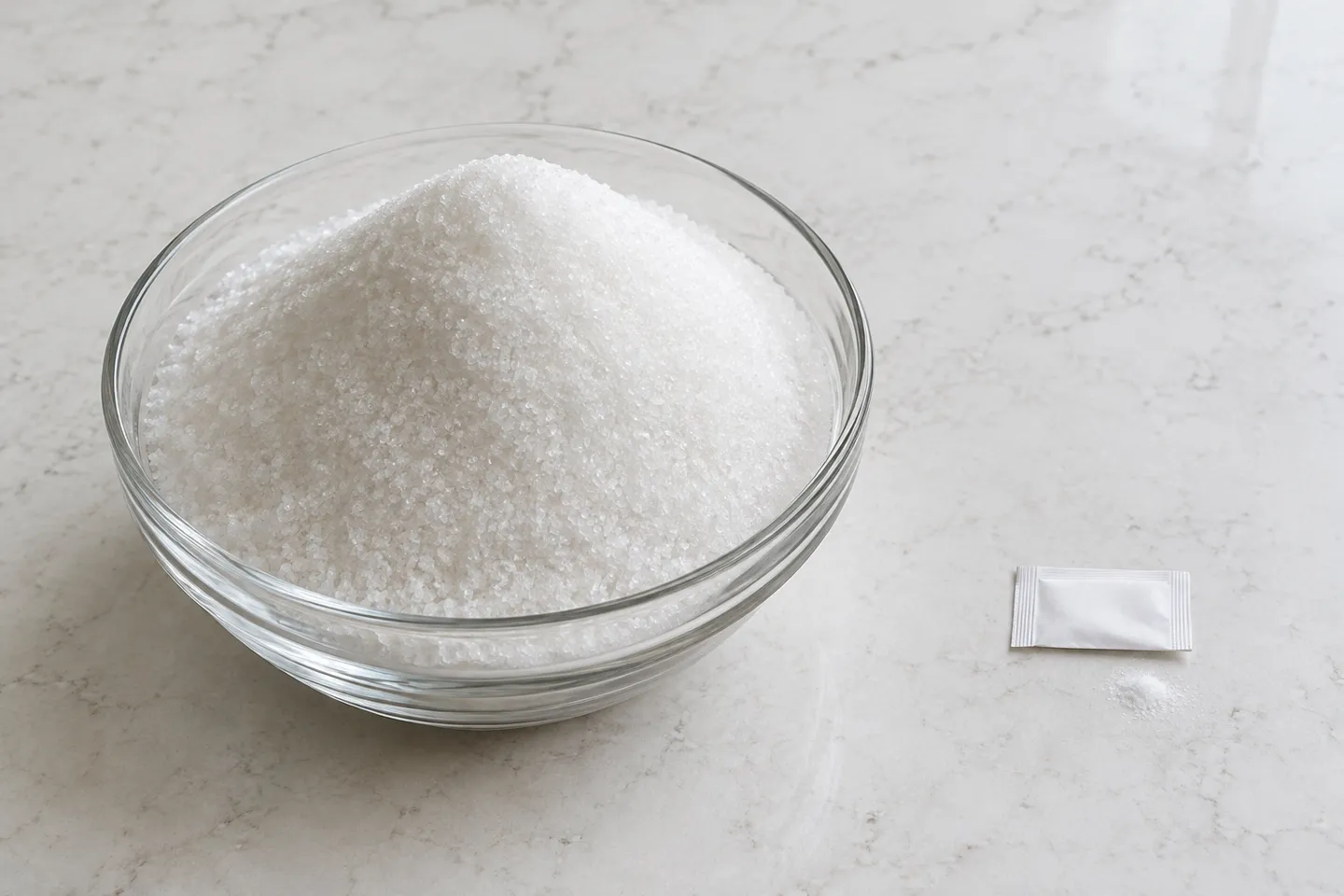
Aspartame is a different species. It is a dipeptide, two amino acids joined together, and the FDA puts its sweetness at about 200 times that of sugar (FDA, 2025). At the doses used in food, its calorie contribution rounds to zero. What it never brings is mass: no volume, no texture, no filling power. It sweetens; it does not fill.
The Two Routes at a Glance
| Недвижимость | Xylitol (bulk route) | Aspartame (multiplier route) |
|---|---|---|
| Сладость против сахара | 0.8-1.1x | ~200x |
| Калории | 2,4 ккал/г | ~0 at use levels |
| Physical job | replaces sugar’s volume and texture | sweetens only |
| Usual home | gum, tabletop, baking, confectionery | diet drinks, powdered mixes, tablets |
| Process limit | heat stable but no browning | loses sweetness when heated |
So the short answer is a reframe. Neither is the “safer sugar”. Xylitol is the candidate when something must replace sugar’s physical work; aspartame is the candidate when only sweetness is needed at the lowest possible calorie cost. The rest of this article supplies the details that decide it. You will see how each one behaves in your mouth, blood, gut, and oven. You will see the mechanism behind every difference, the hard limits on dose, and a scenario table you can act on.
What Each One Actually Does in Your Mouth, Body, and Kitchen
Start with the mouth, because that is where the two diverge fastest. Xylitol dissolves endothermically, pulling heat from your tongue, which is why high-xylitol products feel cool (Dragomir et al., 2025). Polyols also resist the oral bacteria that ferment ordinary sugar into enamel-eroding acid, which is why xylitol chewing gum built an entire dental-friendly category. Aspartame tastes clean and sweet to most people, hits fast, and for a minority it carries a noticeable aftertaste; unlike xylitol it has no effect on teeth either way.
Blood sugar is the next fork. Xylitol is absorbed slowly and incompletely, with a glycemic index around 12, so it nudges glucose rather than spiking it (Dragomir et al., 2025). Aspartame does not convert to glucose at all and does not raise blood sugar. For someone managing diabetes, both can fit, but for different reasons: one is “slow”, the other is “not in the game”.
The gut is where xylitol earns its warnings. Your small intestine absorbs xylitol only partially. The rest reaches the colon, where bacteria ferment it. Past roughly 50 grams per day of polyols, that fermentation shows up as bloating and loose stools (Dragomir et al., 2025). Sensitivity varies widely between people. Aspartame rarely touches the gut; the individual reactions reported with it, mostly headaches, are self-reported and weaker in evidence.
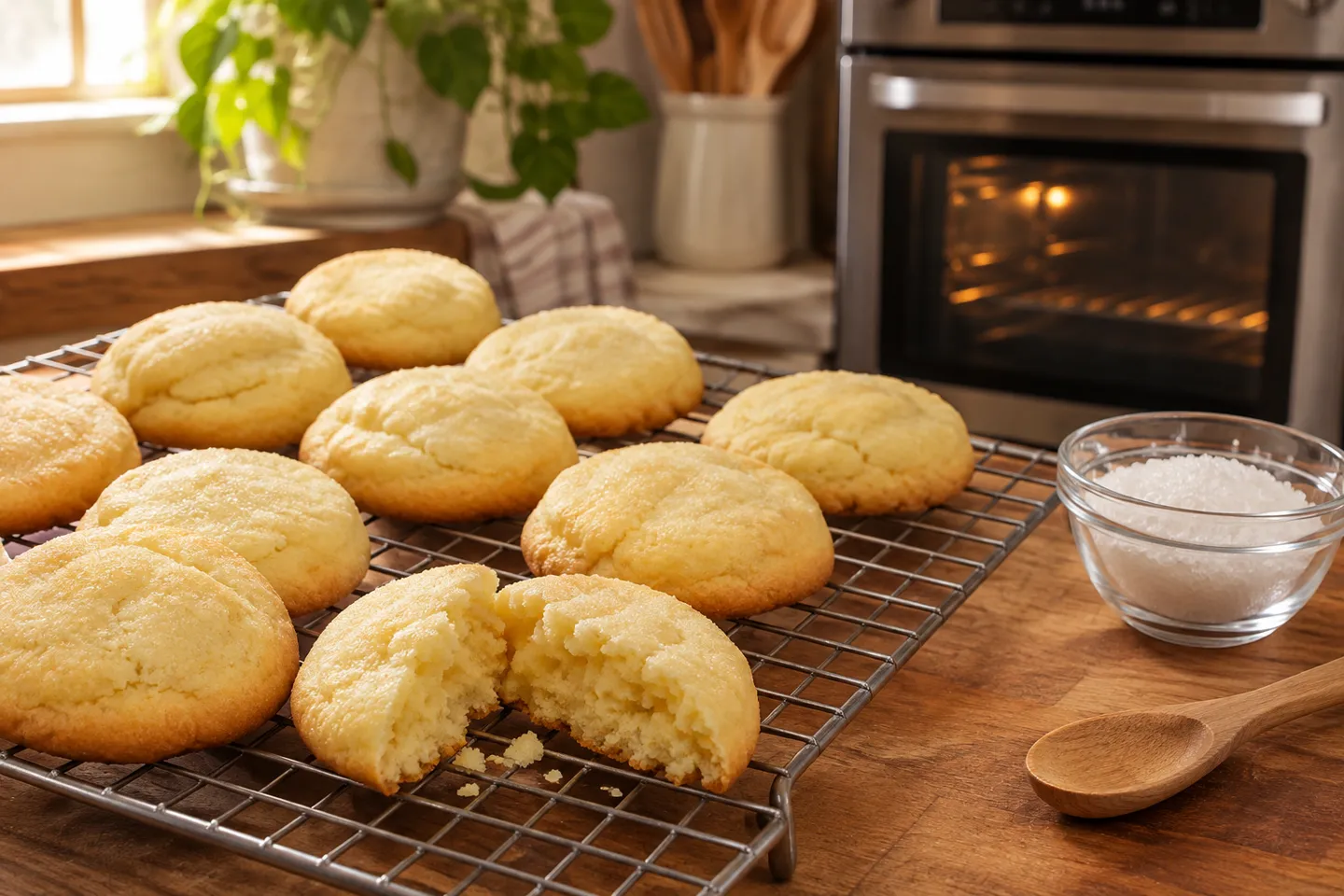
In the kitchen the split is just as sharp. Aspartame is not heat stable and loses its sweetness when heated, which is why the FDA notes it typically is not used in baked goods (FDA, 2025). Xylitol survives heat but refuses to caramelize or brown, so cookies come out paler and slightly wetter than sugar versions.
A practical way to handle symptoms: most xylitol digestive trouble is a dose problem, not an allergy problem. Cut the amount, and count the stack: sugar-free gum plus yogurt plus a protein bar plus “skinny” ice cream in one day adds up faster than any single label suggests. If you suspect aspartame does not suit you, track where it hides (diet drinks, powdered mixes, chewable tablets) for two weeks and see whether the pattern holds. Regulators already encode this dose logic. In the EU, any food with more than 10% added polyols must carry the statement “excessive consumption may produce laxative effects” (Регламент (ЕС) № 1169/2011, приложение III).
Symptom Self-Check
- feeling cool on the tongue = normal polyol behavior, not a reaction
- bloating or loose stools = dose or stacking issue, cut total polyol grams first
- headache after diet drinks = possibly aspartame sensitivity, track sources for two weeks
- pale, wetter baking results = xylitol’s missing browning, not a quality defect
- sweetness vanishing after cooking = aspartame heat loss, switch sweetener or use encapsulated forms
Why: The Two Routes Behind Every Difference
Every difference in the list above traces back to one structural fact: sugar delivers sweetness in bulk, and chemistry learned to deliver it two other ways. Xylitol belongs to the route that replaces sugar by mass. Aspartame belongs to the route that replaces sugar by intensity. Once you see the two routes, none of the differences above look arbitrary anymore.
Why the Sweetness Math Never Lines Up
The bulk route puts sweetness inside mass. Xylitol is close enough to sugar’s sweetness that you swap it gram for gram. The 2.4 kcal per gram it carries is the honest price of having real material in the food (Dragomir et al., 2025). Real material does real work: crumb structure in cakes, creaminess in dairy, the pellet that holds a tablet or a piece of gum together.
The multiplier route puts sweetness inside the molecule itself. Aspartame’s potency is generally cited at 180 to 250 times sugar. The exact number shifts with the food matrix, which is why regulators write limits in parts per million rather than spoons. (Dragomir et al., 2025). A dose that small cannot carry texture. Multiplier sweeteners therefore appear in liquids such as drinks and powdered beverages, or paired with a bulk carrier. They are also blended with other high-intensity sweeteners such as acesulfame-K. That pairing steadies sweetness across a product’s shelf life (Dragomir et al., 2025). The two routes are not rivals; they divide the labor.
Why Heat and Acid Break One but Not the Other
Aspartame’s sweet power lives in a chemical bond (an ester), and heat or low pH breaks that bond. The breakdown yields aspartyl-phenylalanine and a small amount of methanol, and the sweetness simply leaves (Dragomir et al., 2025). This is a shelf-life problem as much as an oven problem: a low-pH drink stored warm loses aspartame sweetness gradually in the bottle. Hence the FDA’s plain wording: aspartame “is not heat stable and loses its sweetness when heated”, so it typically is not used in baked goods (FDA, 2025).
There is an escape hatch, and it is a formal one: encapsulated aspartame, where the sweetener is coated against heat. Canada’s permitted-additive list allows it in unstandardized bakery products at up to 4,000 ppm in the food as consumed. The coating is named as the requirement for surviving baking. (Министерство здравоохранения Канады, 2024). Xylitol needs no such tricks in heat, but it has its own boundary. It does not participate in caramelization or browning. Recipes relying on sugar’s color and crust need help from other browning ingredients.
Why Your Body Processes Them Completely Differently
Xylitol is not a foreign object to your biochemistry: your own body makes about 5 to 15 milligrams of it every day (Dragomir et al., 2025). Swallowed xylitol is partly absorbed and metabolized slowly, partly fermented in the colon (the laxation mechanism above), and lands with a glycemic index near 12. Aspartame is digested, not absorbed intact: it breaks into phenylalanine, aspartic acid, and a trace of methanol, none of which raise blood sugar (FDA, 2025).
That digestion path creates the one absolute exclusion in this entire comparison. People with phenylketonuria (PKU), a rare genetic condition, cannot process phenylalanine, so aspartame is off-limits for them, and the label statement saying a product contains phenylalanine is mandatory (FDA, 2025). Newborns are routinely screened for PKU with a heel-prick test, which is how rare the condition is and how seriously it is taken at the same time.
The Limits: Dose Ceilings, Hard Exclusions, and How to Read the Headlines
Everything safe about either sweetener lives inside a number, and most public confusion is two different numbers being argued as if they were one. This section gives you the actual ceilings, the two exclusions that are not negotiable, and a way to convert the next scary headline into your own arithmetic.
The Dose Ceiling: How Much Is Too Much
For polyols, the threshold that matters is comfort, not safety: total intake across a day above roughly 50 grams is associated with digestive upset (Dragomir et al., 2025). The reference points around it vary by compound. Sorbitol’s cited threshold is about 20 grams per day. Maltitol’s established laxation threshold value is 60 grams in a single meal. Your own line depends on your gut, and stacking is the trap. A few sticks of gum, a fruit yogurt, a protein bar, and a serving of low-calorie ice cream can clear 30 grams before dinner.
The aspartame ceiling is much higher than the headlines suggest, and it is worth memorizing as arithmetic rather than attitude. A 60 kg adult would need roughly 75 packets of aspartame in a single day to reach the FDA’s acceptable daily intake of 50 mg per kilogram of body weight. (FDA, 2025). International bodies use a slightly lower figure of 40 mg per kilogram per day. That is a difference in conservative arithmetic between agencies, not a disagreement that any achievable diet matters to.
The Thresholds That Matter
- ~50 g/dayPolyols (xylitol family): total before digestive comfort suffers
- ~20 g/daySorbitol: reference threshold
- 60 g/mealMaltitol: JECFA laxation threshold
- 50 / 40 mg/kg/dayAspartame ADI: FDA and JECFA
The Hard Exclusions: PKU, Dogs, and the Non-Negotiables
Two exclusions do not bend with dose math. The first is PKU, covered above: for that population aspartame is excluded outright, and the label declaration exists so the exclusion can be enforced at a glance. The second is dogs, and it runs in the opposite direction. Xylitol is gentle on human metabolism, but in dogs it triggers a potent insulin release. Blood sugar can drop to life-threatening levels within 10 to 60 minutes of ingestion, and effects are sometimes delayed up to 12 to 24 hours (FDA). The action list is concrete. Call a vet or animal poison control immediately if ingestion is suspected. Check labels on gum, peanut butter, and toothpaste before they enter a dog’s reach. Treat a single stick of gum as an emergency rather than an experiment.
Keep xylitol products out of dog reach
For dogs, xylitol causes rapid insulin release and life-threatening hypoglycemia within 10-60 minutes. If your dog eats any xylitol-containing product, contact a vet or animal poison control immediately, even if symptoms have not started.
How to Read the Safety Headlines
In July 2023 the IARC classified aspartame as “possibly carcinogenic” (Group 2B). That is a hazard-identification category, based on limited evidence. In the same month, JECFA re-reviewed the risk side and left the acceptable daily intake unchanged. The FDA publicly disagreed with any cancer reading of the classification. (FDA, 2025). Both actions are correct, and they answer different questions. IARC asks whether a substance can plausibly cause harm at some exposure. The ADI answers how much is safe to consume every day for life. The FDA calls aspartame one of the most studied food additives in the supply, with more than 100 studies reviewed.
Xylitol’s headline cycle arrived in 2024, when a Cleveland Clinic study linked higher circulating xylitol levels in blood to platelet reactivity and clot risk (Dragomir et al., 2025). Read it precisely: blood-level association is not the same as a causation verdict on dietary xylitol, and the GRAS status did not change. The useful habit is the same for both sweeteners: when the next headline lands, convert it into your own numbers. Compare your actual daily packets or grams against the ADI arithmetic above, and the panic usually shrinks to a decision you can make at the shelf.
Which One Fits Your Situation
The matrix below compresses everything above into the seven situations readers actually bring. The last column matters most: it is the boundary, and the action to take when the boundary bites.
Scenario Cheat Sheet
| Ваша ситуация | Better fit | Why | Boundary and what to do |
|---|---|---|---|
| Hot coffee or tea | Либо | xylitol adds body and coolness, aspartame is calorie-free and fast | aspartame’s aftertaste bothers some people: test one brand before bulk-buying |
| Домашняя выпечка | Ксилит | it survives oven heat and carries texture | xylitol will not brown or caramelize: expect paler crusts and adjust liquids, or look for encapsulated aspartame products where regulations allow |
| Sugar-free gum and oral care | Ксилит | the dental-friendly category was built on it | doses stack fast across mints and gum: keep the daily total in mind |
| Контроль уровня сахара в крови | Либо | xylitol is slow (GI ~12), aspartame is absent from glucose metabolism | xylitol still carries 2.4 kcal/g and counts toward your carbohydrate budget |
| Weight loss | Aspartame | sweetness at near-zero calories | it fixes sweetness but not volume: low-calorie does not mean low-satiety, and “sugar-free” polyol snacks still carry calories |
| House with dogs | Aspartame (for storage) | xylitol is an emergency for dogs even in small amounts | store all polyol products high and closed; any suspected ingestion goes straight to a vet |
| Bottled low-pH drinks | Aspartame | stable at low pH in cold storage and cheap at scale | warm storage shortens sweetness shelf life; blends with acesulfame-K hold sweetness longer |
Two habits make the table work in real life. Read the ingredients list for the word hiding in plain sight: xylitol may appear as “birch sugar”, and polyol blends are everywhere in “sugar-free” aisles. And when a choice falls between the rows, go back to the dose section: total grams per day for polyols, packets per day versus ADI for aspartame.
What the Sweetener Debate Means for Ingredient Buyers
The same headline cycle that confuses shoppers carries different information for someone who buys sweeteners for a living. The two routes absorb public controversy differently, and that asymmetry is a portfolio fact, not a news item. High-intensity sweeteners take the hazard-identification headlines, aspartame’s Group 2B moment being the latest. Those headlines rattle consumer sentiment, but they leave demand arithmetic intact. Artificial sweeteners as a market were valued around 2.9 billion dollars in 2024, with projected growth to about 5.4 billion by 2033. Aspartame alone still held roughly half the artificial-sweetener market by value in 2025 (Dragomir et al., 2025). Bulk polyols take the softer science: tolerance thresholds and labeling rules such as the EU’s 10% laxation statement. Those shape formulation practice, but they never produce a panic headline.
For a distributor weighing which sweetener categories deserve shelf and warehouse space, that asymmetry suggests a tilt rather than a swing. The bulk route carries steadier demand drivers (dental care, diabetes-friendly positioning, “natural-derived” perception) and a safety narrative that limits dosage rather than the ingredient itself. The multiplier route remains the cost-effective answer for beverages and other mass-sweetening applications, and no regulatory body has moved its ADI. Rebalancing a portfolio on each headline has historically been the losing trade. The calmer read is to weight stock toward the route whose worst news is “eat less at once”. Keep the high-intensity line for the applications where only it makes economic sense.
The same discipline applies to sourcing. Ingredient quality in this category is a specification conversation, not a sentiment one. Assay range, particle size, moisture, and heavy-metal limits are where a supplier is actually vetted. Conformance with pharmacopoeia standards (USP, BP, FCC) is the fastest way to separate commodity lots from controlled ones.
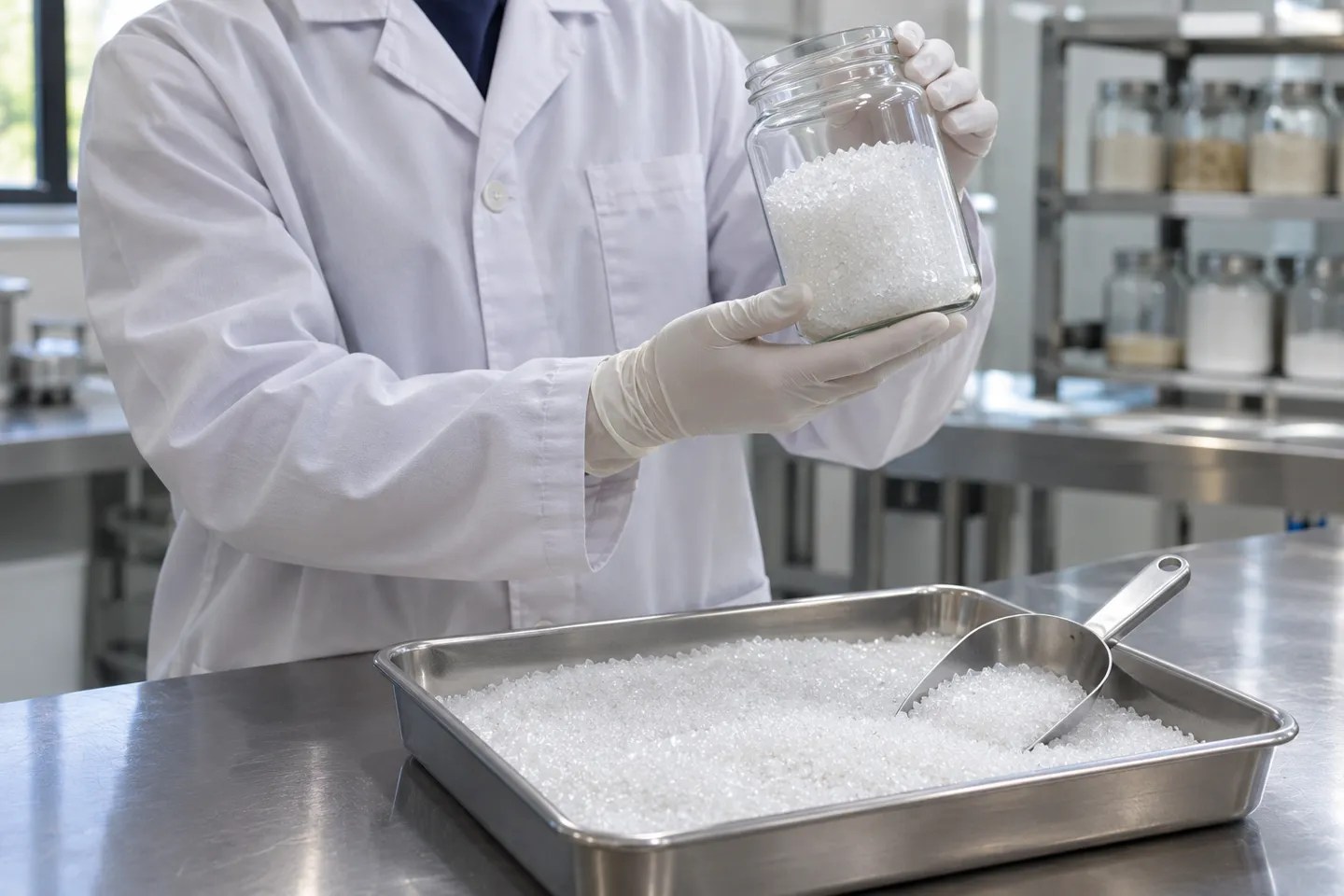
As one example of what a specification-first listing looks like, Saigao’s xylitol is produced to USP/BP/FCC reference standards with an assay of 98.5% to 101.0% and mesh options of 10-40, 20-60, or 100 (Технические характеристики ксилита). If you are comparing suppliers, start from the sheet, not from the headlines.
For ingredient buyers
Source Xylitol to USP/BP/FCC Standards
Assay, mesh, moisture, and heavy-metal limits documented: tell Saigao your spec and get a quote for your volume.
Start an Ingredient InquiryСсылки
- Управление по контролю за продуктами и лекарствами США. “Аспартам и другие подсластители в продуктах питания”. 2025 г. fda.gov
- Dragomir, N. et al. “Beyond Sugar: A Holistic Review of Sweeteners and Their Role in Modern Nutrition.” 2025. pmc.ncbi.nlm.nih.gov
- Health Canada. “List of Permitted Sweeteners (Lists of Permitted Food Additives).” 2024. canada.ca
- Управление по контролю за продуктами и лекарствами США. “Не давайте собакам ксилитол — он опасен для них”. 2024 г. fda.gov
- “Regulation (EU) No 1169/2011 on Food Information to Consumers, Annex III.” legislation.gov.uk
 English
 Russian
 Spanish
 French
 Arabic