
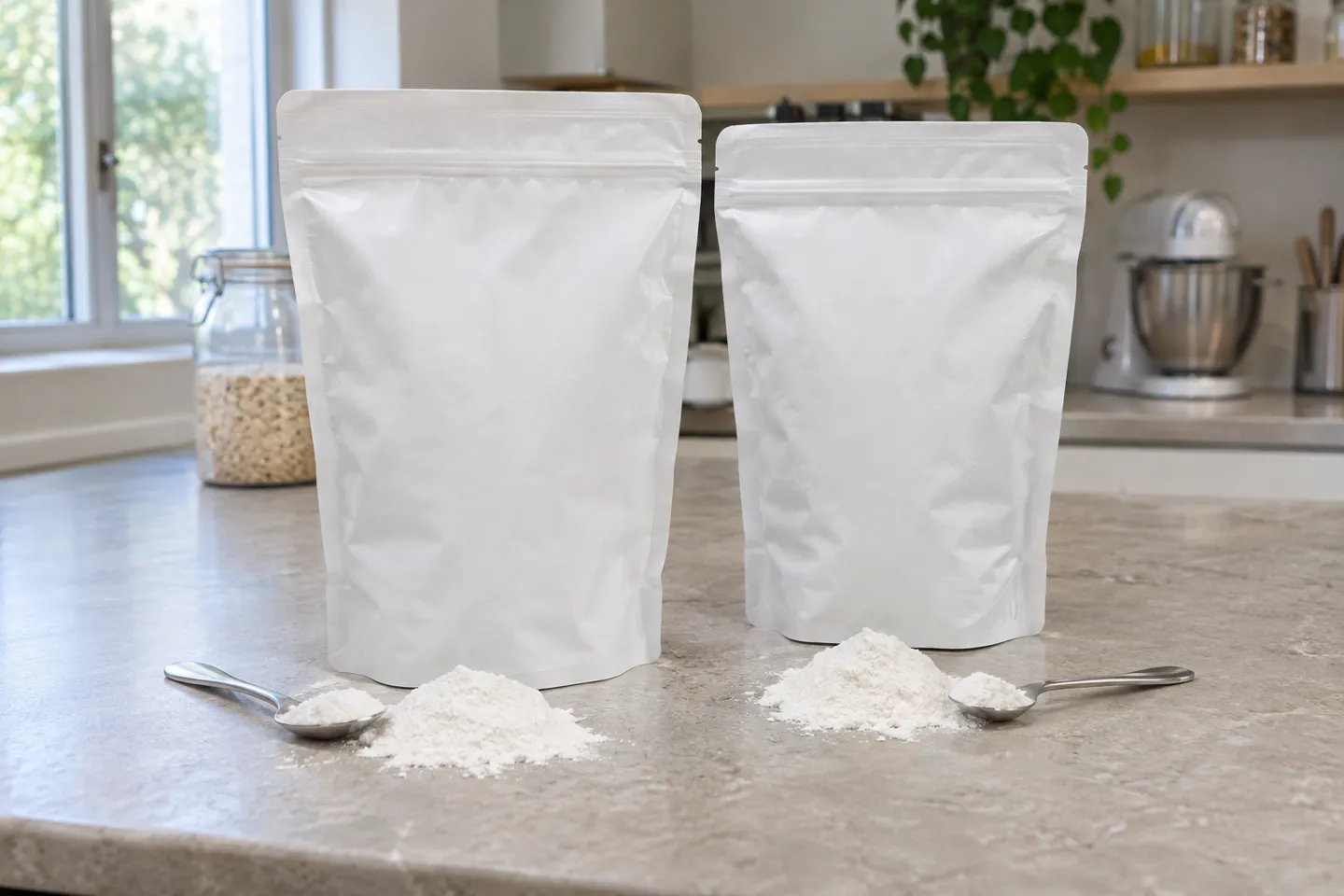
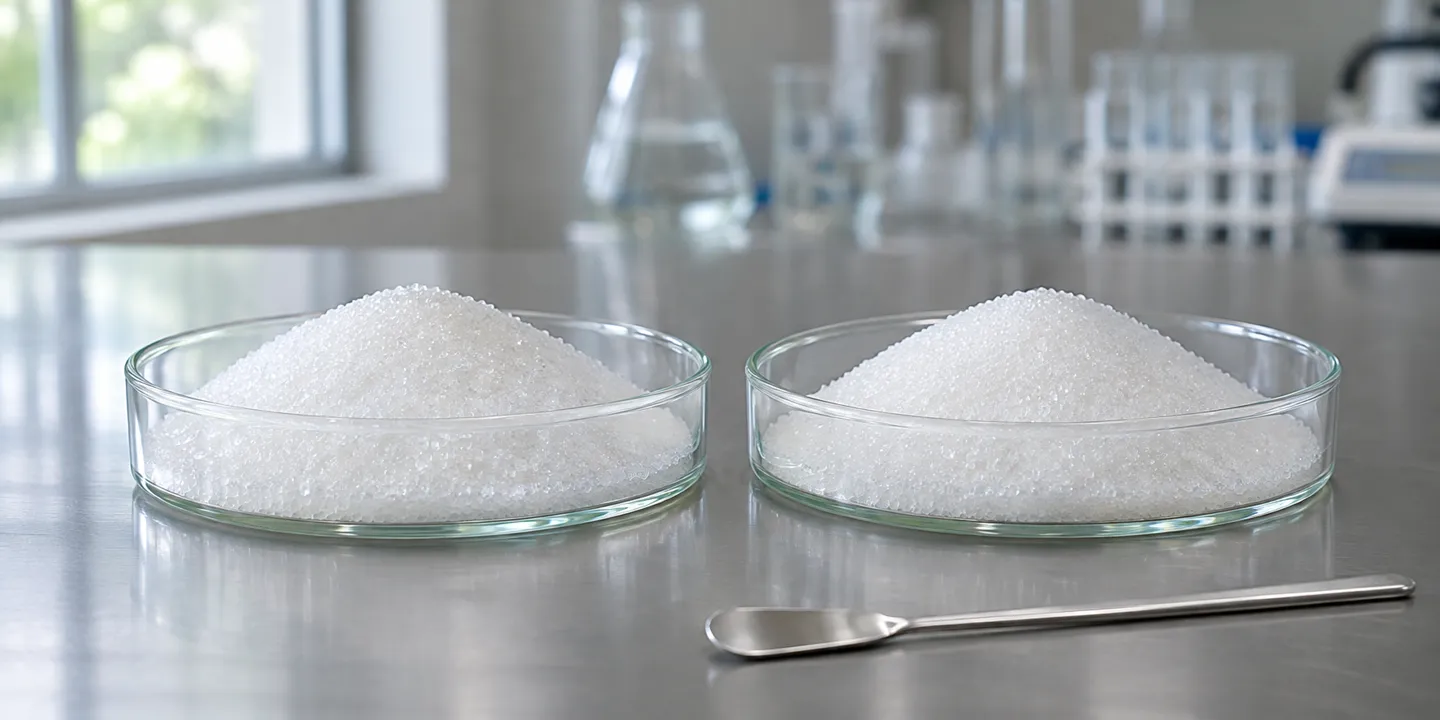
The sample bags look almost the same: white, free-flowing powder, both promising sugar-free sweetness without a bitter finish. One is allulose, one is xylitol, and a product developer, a regulatory reviewer and a buyer will each reach a different conclusion about which bag belongs in the product. That is not confusion. The two sweeteners sit in different chemical families, so they behave differently in the body, in the mixer, on the label and in the supply chain. This guide walks those differences in the order a real project meets them.
What Allulose and Xylitol Actually Are
The family difference decides almost everything else. Allulose is a rare sugar found naturally in figs, raisins and wheat, and it is produced commercially by converting fructose with an enzyme (Cleveland Clinic, 2024). Xylitol is a sugar alcohol, or polyol, processed from plant fiber such as xylan and used in sugar-free products for decades (Harvard Health Publishing, 2024). One passes through the body mostly unmetabolized. The other is absorbed and partly fermented in the gut.
The basic numbers separate cleanly. Xylitol matches sucrose at one-to-one sweetness and carries 2.4 calories per gram against sugar’s 4 (Harvard Health Publishing, 2024). Allulose delivers roughly 70% of sucrose’s sweetness, and FDA guidance values it at 0.4 calories per gram (Administración de Alimentos y Medicamentos de Estados Unidos, 2020). On blood glucose, allulose does not raise glucose or insulin levels (Cleveland Clinic, 2024). Xylitol sits low but not at zero: a glycemic index around 7 against sugar’s roughly 60 (Harvard Health Publishing, 2024).
Gut tolerance flips the favor. Polyols ferment in the large intestine, so too much xylitol too fast brings gas, bloating and diarrhea (Harvard Health Publishing, 2024). Allulose is gentler for most people, though very large servings can cause bloating as well (Cleveland Clinic, 2024). On teeth, xylitol holds the longer record: reviews find that 5-10 grams per day from gum, lozenges or toothpaste meaningfully reduces cavities (Harvard Health Publishing, 2024). A 2025 laboratory study adds one more data point: allulose does not drop plaque pH below the 5.5 threshold where enamel demineralizes (Ruby et al., PubMed Central, 2025). On that evidence it is not considered cariogenic.
Two safety edges matter for labels and for homes. Xylitol is highly toxic to dogs (Administración de Alimentos y Medicamentos de Estados Unidos, 2025). Veterinary references put severe liver failure risk at doses above roughly 0.5 grams per kilogram of body weight (Manual Veterinario de Merck, 2026). Allulose carries GRAS status in the US, and the “hard on the liver” claim circulating on social media has no published evidence behind it (Cleveland Clinic, 2024). One open question belongs to xylitol. An observational study in the European Heart Journal linked high circulating xylitol levels to later heart attack and stroke (Harvard Health Publishing, 2024). The study’s authors themselves flag that the signal needs more research.
None of these facts decides an ingredient choice on its own. They set the boundary conditions. The actual decision happens downstream, where the two powders stop behaving like siblings.
Allulose vs Xylitol at a Glance
| Attribute | Alulosa | Xilitol |
|---|---|---|
| Chemical family | rare sugar | sugar alcohol (polyol) |
| Dulzor frente a sacarosa | about 70% | 1:1 |
| Calorías por gramo | 0.4 (FDA valuation) | 2.4 |
| Blood glucose effect | none detected | low, GI about 7 |
| Gut tolerance | bloating only at very large servings | gas and diarrhea at large servings |
| Dental evidence | not cariogenic (2025 lab data) | cavity reduction at 5-10 g/day |
| Tóxico para los perros | no known risk | highly toxic |
How Each One Behaves in a Real Recipe
Sweetness tables end where formulation begins. In a development kitchen, the expensive questions are not about sweetness at all. They are about what each sweetener does to color, texture, water and cost once it enters your process.
Browning: where allulose commits and xylitol abstains
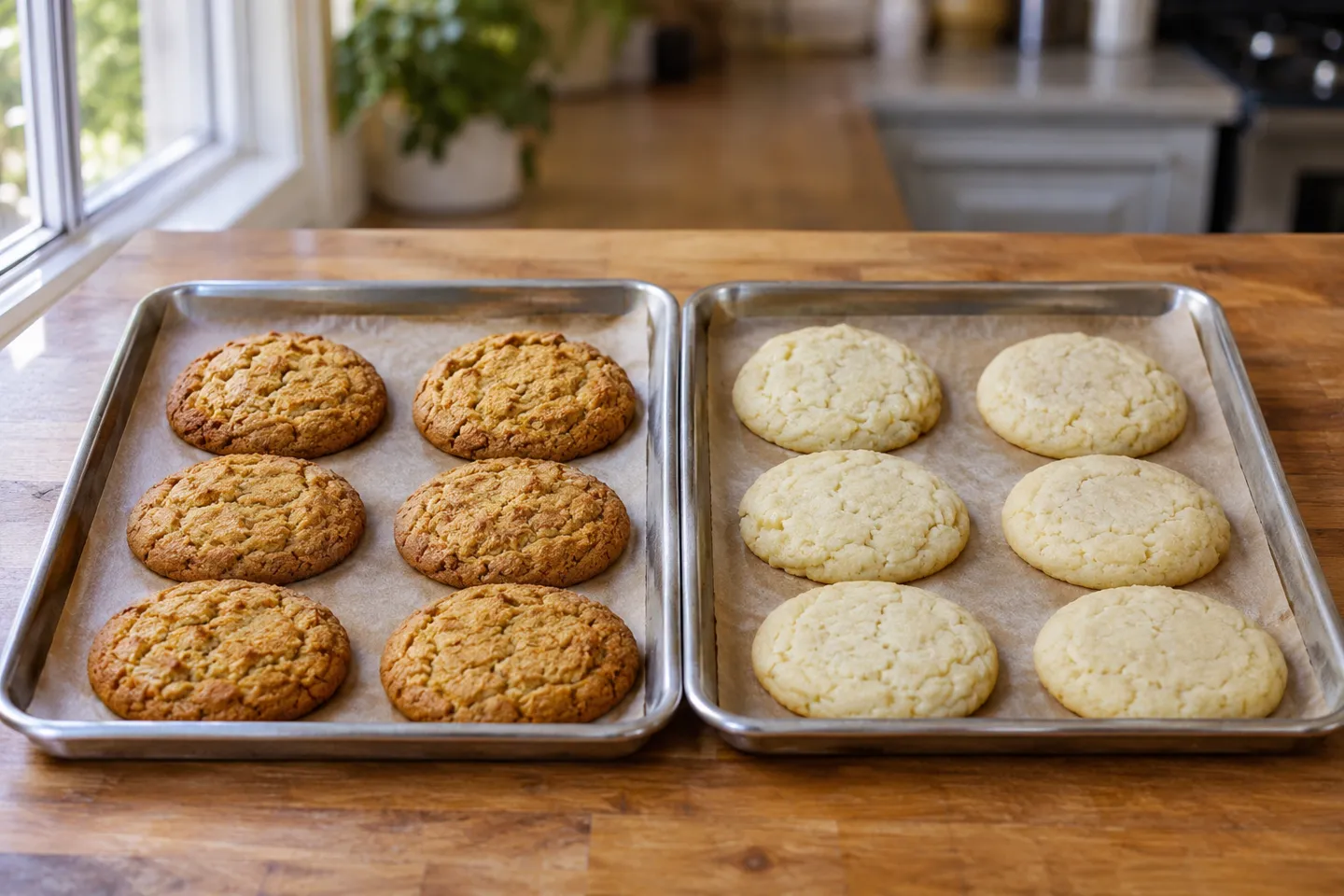
Allulose is a reducing sugar, so it drives Maillard browning and caramelization. At the same oven temperature, cookies, glazes and crusts built on allulose color faster and darker than their sucrose versions. Treat that as a parameter, not a defect: drop the bake temperature or shorten the time, and start checking color from the midpoint of the bake. Xylitol contributes almost no browning. A xylitol-sweetened loaf comes out pale, which is invisible in a white cake and disqualifying in an artisan crust. If your product sells on color, run a bake test before locking the formula, because no sweetness number predicts it.
Freezing point and crystallization: soft scoops versus structured tablets
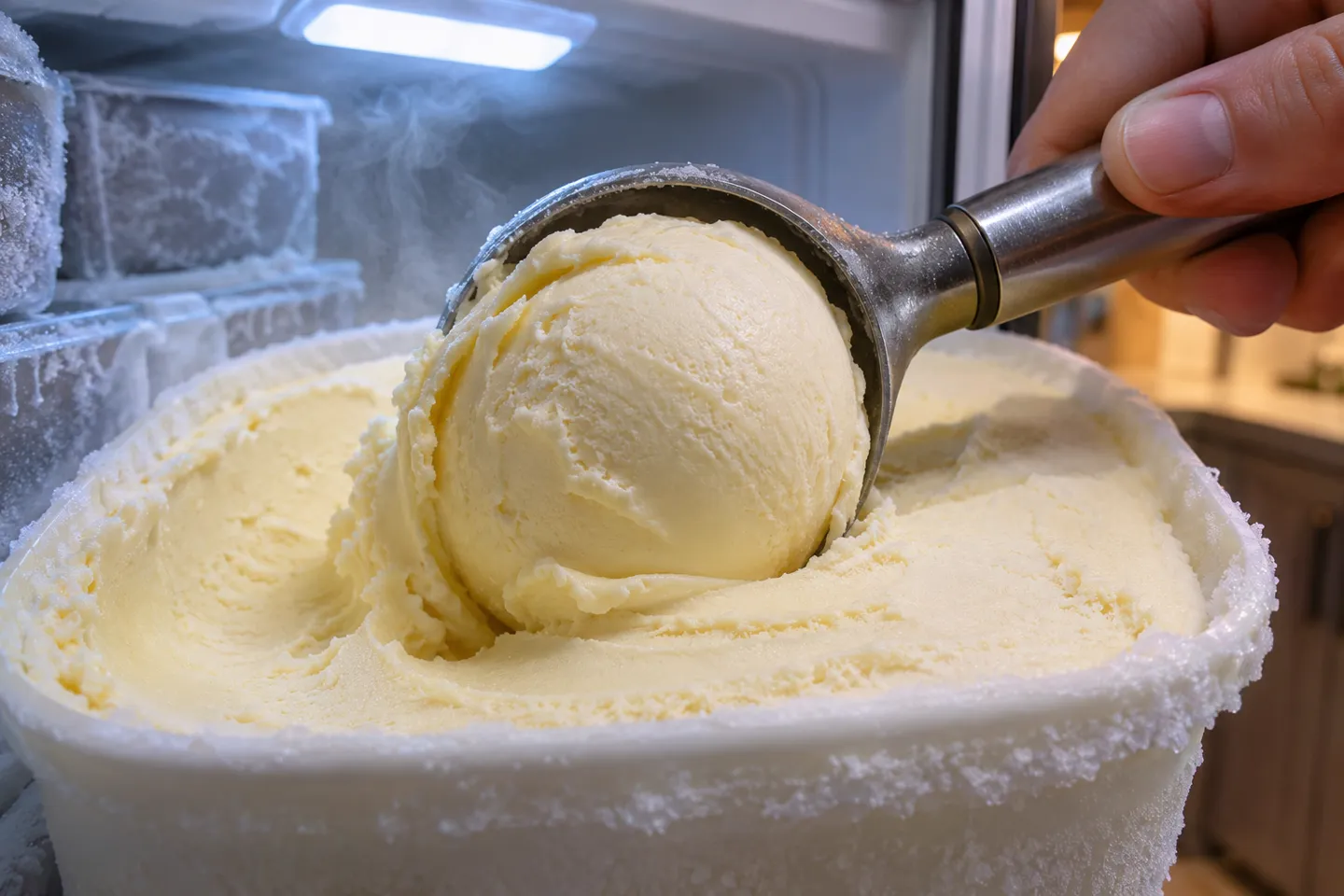
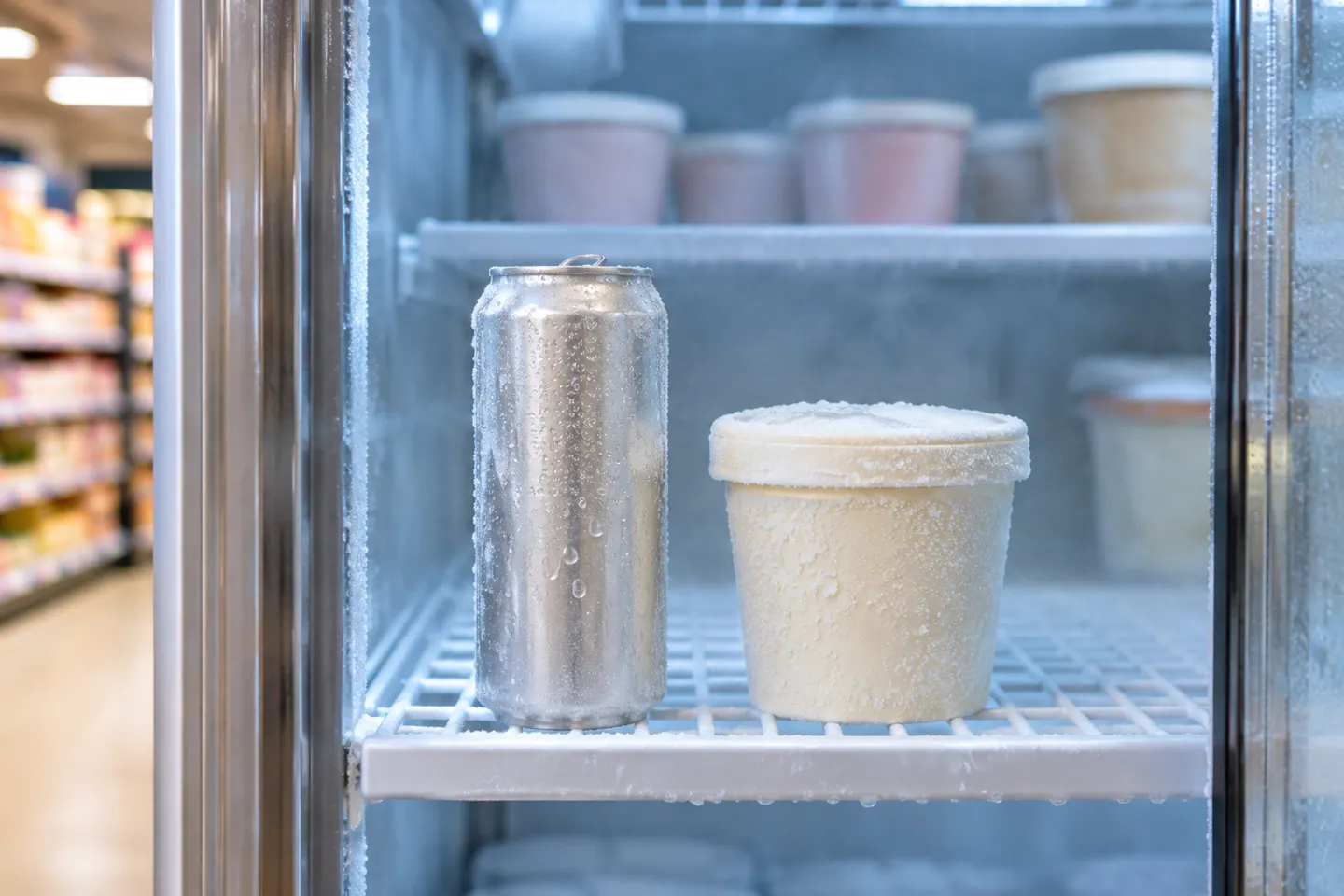
Both sweeteners depress freezing point more than sucrose does, which is why reduced-sugar ice cream scoops soft straight from a home freezer. Allulose goes further: it interferes with crystallization, keeping frozen desserts smooth and syrups from graining. Xylitol does crystallize, and in the right product that is a feature. Pressed mints and tableted candy need a structured, dry surface, and xylitol provides it. Xylitol also has a strong negative heat of solution, meaning it draws heat as it dissolves, and the mouth reads that as a cool sensation. Chewing gum and mints want that effect. Warm beverages and baked goods do not.
Moisture, flow and storage
Xylitol is hygroscopic. In humid warehouses it pulls moisture, cakes in the bag and can shorten the texture life of chewy products. Allulose powders are moisture sensitive too, which is one reason allulose is often supplied as syrup for high-moisture applications; syrup sidesteps caking but changes how you dose it. Either way, the specification has to say so. Set a water activity limit, define warehouse humidity ranges, and choose packaging barrier before scale-up, not after the first clumped pallet.
Blending: who supplies the body
High-intensity sweeteners such as stevia, sucralose and monk fruit deliver sweetness with no bulk, no browning and no freezing point effect. Every reduced-sugar formula therefore needs a bulk sweetener, and allulose and xylitol are the two candidates with the most sugar-like body. Allulose’s 30% sweetness gap gets closed by pairing it with a high-intensity partner, and blends of allulose with erythritol are already the default base in keto frozen desserts and beverages. Xylitol can carry a formula alone at 1:1 replacement, which keeps the ingredient statement short and the process familiar.
Recipe Behavior Side by Side
| Attribute | Alulosa | Xilitol |
|---|---|---|
| Browning | strong, reducing sugar | almost none |
| Punto de congelación | strong depression | strong depression |
| Cristalización | suppressed | present, useful in tablets |
| Sensación refrescante | ninguno | noticeable, draws heat when dissolving |
| Comportamiento frente a la humedad | sensitive, often supplied as syrup | hygroscopic, cakes in humidity |
| Bulking | yes, needs sweetness top-up | yes, carries a formula alone |
These behaviors are testable long before a launch date, which is exactly why they belong in the spec conversation rather than the complaint file. A pilot run on your own line surfaces all of them within a week.
Three failure modes to design out before scale-up
- Allulose over-browning: lower the bake temperature and watch color early.
- Xylitol caking in humid storage: set a water activity limit and specify barrier packaging.
- Xylitol products within pet reach: add pet-warning copy to the pack.
Which One Fits Your Product and Market
In the United States, FDA’s final guidance exercises enforcement discretion to exclude allulose from Total Sugars and Added Sugars on the Nutrition Facts label (Administración de Alimentos y Medicamentos de Estados Unidos, 2020). The same guidance values allulose at 0.4 calories per gram. A beverage built on allulose can carry a zero added sugars line and mean it. The same formula built on xylitol cannot, because polyols are declared on the label with their caloric value (Icon Foods, 2026).
In the European Union, that second option does not exist commercially. Allulose has not completed the EU novel food authorization process. EFSA’s 2025 opinion concluded that the available data did not establish its safety, so D-allulose is not authorized for EU sale today (EFSA, 2025). EU-bound products are built on authorized polyols instead, with a laxative warning convention at significant polyol loads (Icon Foods, 2026).
The same sweetener that lets a US label say zero added sugars cannot legally enter a product sold in the EU today.
That single fact reorganizes the comparison. “Which is better” has no stable answer, because the answer changes by product category and by destination market. The matrix below reads by row.
Application Fit Matrix
| Aplicación | Better Fit | ¿Por qué? | Boundary to Check |
|---|---|---|---|
| Bebidas | allulose system | zero-sugar label, neutral taste | EU sale not authorized |
| Bakery, colored and artisan | alulosa | browns like sugar | retune bake temperature and time |
| Bakery, pale and mass-market | xylitol | no browning to manage | humidity control against caking |
| Ice cream and frozen desserts | allulose, often with erythritol | freezing point drop plus anti-crystallization | dose drives softness, pilot test first |
| Pressed tablets and confectionery | xylitol | crystallizes into structure, dental claim | laxative warning at high polyol loads |
| Gum and oral care | xylitol | cooling sensation plus dental evidence | pet-warning copy on pack |
| Tabletop sweetener | either, by market | xylitol at 1:1 and lower cost, allulose for keto claims | destination market availability |
Demand is also moving. Market researchers project the allulose market to grow from USD 0.2 billion in 2024 to USD 0.98 billion by 2035, a 15.5% annual growth rate (Market Research Future, 2025). North America absorbs around 60% of that demand. Growth like that concentrates on qualified supply. For a buyer, the practical reading is short: specifications and supply relationships locked now will matter more than this quarter’s spot price.
Momentum in three numbers
0,4 kcal/g
FDA valuation of allulose calories
15.5%
Projected allulose market CAGR through 2035
~60%
Share of allulose demand in North America
Sources: Market Research Future, 2025; U.S. FDA, 2020
How to Lock a Supplier and a Spec
Once the sweetener system and destination markets are set, the remaining risk sits in the supply chain. Five steps close most of it.
Buy the spec sheet before the price. The sheet should state purity assay, moisture, particle size distribution, physical form (powder, granule or syrup) and water activity. On allulose, color and crystal uniformity are process-quality signals: a near-white, consistent crystal points to a mature process, while dark or variable lots predict color trouble in your finished product.

Match the certification pack to the destination market. ISO 9001, ISO 22000, HACCP, Kosher, Halal and non-GMO (IP) form the baseline for food ingredients. An EU-bound file also needs documentation that matches EU market requirements, so confirm that before the first shipment rather than at customs.
Sample, then pilot, then commit. A lab sample gets verified against its COA for purity, microbiology and heavy metals. A pilot run then puts the ingredient through your own line, because browning, solubility and flow behavior only reveal themselves in your process. Skipping the pilot is the most common way a clean spec sheet turns into a rejected shipment.
The verification gate
Lab sample
COA check
Pilot run
Your own line
Commit
Spec, then volume
Negotiate commercial terms that match your volume reality. Cover MOQ, the difference between stock and made-to-order lead times, and customization: particle size, purity and packaging adjusted to your line. Powder grades generally ship faster, while syrups are frequently produced to order.
Contract the after-sale basics. Batch-by-batch COA, stability data for acidic applications, and a defined response window when something goes wrong belong in the agreement, not in a promise made on a call.
The supplier lock-in checklist
- Spec sheet states purity, moisture, particle size, form, water activity
- Certification pack matches destination market
- Lab sample verified against COA
- Pilot run completed on your own line
- Commercial terms cover MOQ, lead time, customization
- After-sale terms cover batch COA, stability data, response window
A price-only comparison hides the variables that generate claims and returns: color, crystal uniformity and batch-to-batch stability. Those differences surface in your product, never on the invoice.
Those variables live in the spec conversation: send your target spec and application, and the SAIGAO team will match it against both lines.
The Sourcing Playbook, Reread
Read back through the chain and one conclusion repeats at every layer. In the body, the chemical family decides metabolism and tolerance. In the recipe, the same difference decides color, texture and storage behavior. On the label, it decides what you may claim and where you may sell. These are not two grades of one sweetener. They are two different tools that happen to look alike in a bag.
Why single-sweetener bets fail
Every failure mode traces back to a fact already established above. A US clean-label line built only on xylitol gives up the added sugars exclusion that allulose earns. An EU line built only on allulose has no legal ingredient to buy. A cost-driven bulk category priced on allulose, such as gum or mass-market bakery, donates margin to a mature polyol. A premium line sweetened only by high-intensity agents loses the body that bulk sweeteners supply. Every one of these is a structure failure, and taste is beside the point.
The working playbook is therefore dual-track by market and category. US clean-label formulations run an allulose system, paired with high-intensity sweeteners to close the sweetness gap. EU lines and cost-sensitive bulk categories run a xylitol system. Premium lines blend allulose with high-intensity partners to dilute ingredient cost while keeping body. With allulose demand compounding while qualified supply stays concentrated, locking specifications and supply relationships now beats chasing spot price. When EFSA’s review eventually moves, re-read the matrix above: the rules will have changed, not the chemistry.
That dual-track playbook is how we run our own book at SAIGAO. Our allulose range comes out of a process refined over years of iteration, with the near-white color and uniform crystal that browning-sensitive formulas depend on. Our xylitol specifications cover powder and granule forms for gum, oral care and bulk bakery work. Both lines can be adjusted across purity, particle size, form, DE value, pH, water activity and packaging, so the spec sheet you lock is the spec sheet that ships. If you are mapping a formulation against the matrix above, compare nuestra gama de alulosa y our xylitol specifications side by side. We will send samples against your target spec.
Put SAIGAO allulose and xylitol on your bench
Allulose and xylitol lines in powder, granule and syrup, with purity, particle size, water activity and packaging adjusted to your line and destination market.
Request your spec packageReferencias
- Cleveland Clinic. “Allulosa: qué es y cuáles son sus efectos secundarios”. 2024. health.clevelandclinic.org
- Harvard Health Publishing. “Xylitol: What to know about this popular sugar substitute.” 2024. harvardhealth.org
- Ruby, J.D. et al. “The effect of allulose, sucralose, and xylitol on Streptococcus mutans.” PubMed Central. 2025. pmc.ncbi.nlm.nih.gov
- U.S. FDA. “Guidance for Industry: The Declaration of Allulose and Calories from Allulose on Nutrition and Supplement Facts Labels (Final Guidance).” 2020. fda.gov
- U.S. FDA. “Paws Off Xylitol; It’s Dangerous for Dogs.” 2025. fda.gov
- Merck Veterinary Manual. “Xylitol Toxicosis in Dogs.” 2026. merckvetmanual.com
- EFSA. “Safety of D-allulose as a novel food pursuant to Regulation (EU) 2015/2283.” 2025. efsa.onlinelibrary.wiley.com
- Market Research Future. “Allulose Market Size, Industry, Demand, Growth, Trend 2035.” 2025. marketresearchfuture.com
 English
 Russian
 Spanish
 French
 Arabic